
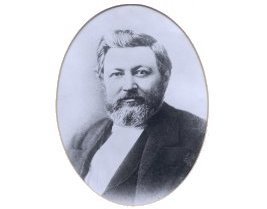
(Editor’s note: First in a series)
The Crutchfield name became familiar to Chattanoogans within weeks of Thomas Crutchfield Sr.’s arrival here in the early 1830s. Word had spread to Greeneville, Tennessee, that land was available in the southeastern part of the state, and Crutchfield speculated that he could prosper there. He and his brother-in-law soon established a brick kiln near the Tennessee River and produced “fine bricks” for the homes of prominent citizens, including James Whiteside and Dr. Milo Smith.
As his business prospered, Crutchfield became more involved in Chattanooga’s civic leadership and assessed the future of the town. The entrepreneur decided to build one of the first hotels along a street he believed would become a hub of commerce and transportation. Having been involved in the first surveys of Chattanooga, Crutchfield saw the town’s future as a transportation hub connecting newly expanding railroad systems. He began negotiations with the Western and Atlantic railroad and the State of Georgia to bring the northern terminus of the line to Chattanooga. However, he died before the dream was realized. The Crutchfield House opened in 1847, and the father’s involvement in local business, civic and governmental affairs was inherited by his son, Thomas.
Thomas Crutchfield Jr. witnessed the growth of the town during the turbulent years of the 1850s. The Georgia Journal and Messenger on Feb. 2, 1853, carried the announcement that Crutchfield had been awaiting. “We mentioned in our last issue that Governor Cobb and Mr. Wadley, the General Superintendent” were going to Chattanooga with the purpose of choosing the site for the planned railroad depot. Their scheduled meeting with the president and the chief engineer of the Nashville and Chattanooga Railroad was delayed when the two Tennesseans were detained in Nashville. Instead of rescheduling the site visit, the Georgians announced that the “general passenger Depot shall be immediately in front of the Crutchfield House, occupying the stand which is now used by the passenger train. This, we learn, will be a tasty edifice.” The report also mentioned that the depot would be located close to Market Street and “near A.H Johnston’s and Colonel Griffin’s produce business.”
The Messenger’s article also stated that the depot would be about 400 feet in length with an “ample platform” that would allow the easy transfer of cotton, produce and other goods. At the same time, the Nashville and Chattanooga Railroad would be offered land “to erect a local depot south of the Crutchfield House, which will bring the two roads together and also form a very convenient arrangement … . The city will wear a very different aspect and appear much more business-like than at present.”