
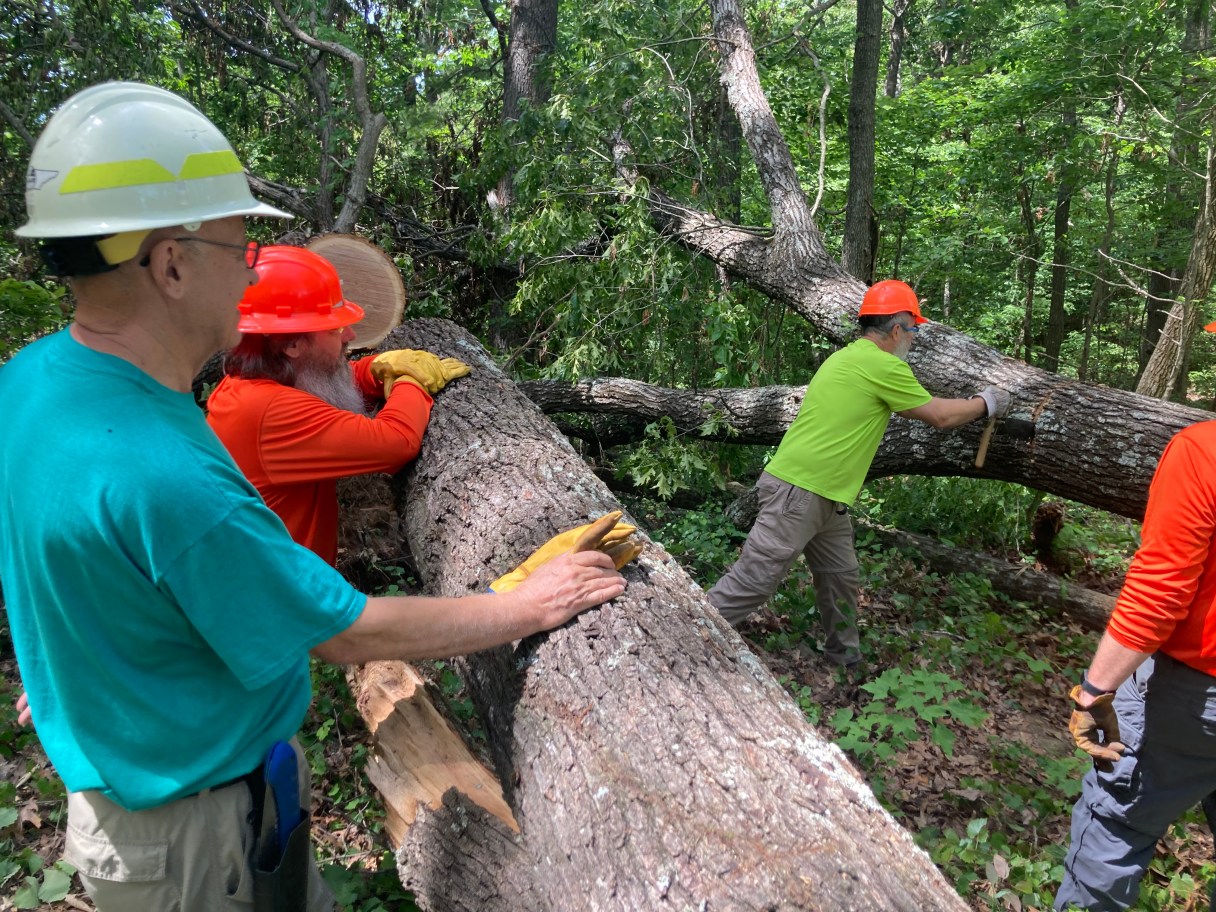

Storms that tore through the Cherokee National Forest in East Tennessee and North Georgia in April and May downed hundreds of trees along the Benton MacKaye Trail in both states.
Members of the Cherry Log, Georgia-based Benton MacKaye Trail Association said more than 6 miles of the trail were “obliterated” where mechanized equipment is banned, so the cleanup took weeks, according to a statement about the damage. All-volunteer crews put in more than 360 hours to repair and clear the trail.
“Just with normal seasons in the springtime and early summer, we get a lot of rain,” said Bob Cowdrick, president of the association.
“But this year, it was not only the rain but high winds. High winds cause trees to fall,” Cowdrick said in a phone call. “Our crews have been working to get those trees — we call them ‘blow-downs’ — off the trail. When it’s not in a wilderness area, it’s pretty easy and you can use a chainsaw, but in Tennessee, a lot of our trails are in wilderness areas, and you can’t use them.”
Instead, crews use tools that go back a century or more.
“They use crosscut saws — old 1920s, 1930s crosscut saws — to take those trees out,” he said. “It increases the difficulty by four or five times. One tree can take two or three people an hour or more to clear off. It’s a lot more work.”
Cowdrick estimated crews had removed at least 200 trees from the storm-torn trail since April.
Safety is a high priority after a major storm strikes, according to the association.
Hikers should not attempt to navigate a trail that has sustained significant damage because getting lost or injured “is a very real possibility,” Joy Forehand, spokesperson for the association, said in a statement on reopening the trail. “Still, there always are a few intrepid hikers who refuse to be deterred. The initial prep work for clearing the trail does help these hikers find their way over, under, around or through the blockages, but it is far from a guarantee of a safe or successful trek.”
On the other hand, those die-hard hikers are often an asset when developing plans for reopening because they can provide photos and GPS coordinates of damaged areas so volunteer crews can determine their approach. The work is dangerous, Forehand said, and crews need all the help they can get. Treetops in damaged sections of the trail were so massive and numerous, the trunks of the trees were hidden from sight.
In some cases, large trees had fallen across the root balls of other massive trees, Forehand said, slowing the work to a crawl.
“Crews had to open pathways to the trunks before the sawyers could begin the work to clear the trail,” Forehand said. “The first crew’s foray to do maintenance was anything but encouraging. Removing blow-downs and large limbs as they went, they made it only 100 yards — not a positive preview of what was to come.”
Progress was slow because of the density of the downed trees, she said. Some of the largest limbs were 30 inches in diameter, as large as many of the downed trees. Some of the larger trees were 4 feet across.
“In some areas, the distance between trees was only a step or two,” Forehand said. “As soon as the trail workers removed one blow-down, they would take a step or two, and they were at the next tree to take out.”
Forehand said 36 volunteers, including 21 certified sawyers, were on hand for the final push to clear the trail on a work trip earlier this month.
“Any storm-damaged trail is reopened now,” Forehand said in a follow-up phone call. “That’s what we’re supposed to do. We tell the congressional staff that we maintain the trail, and we keep it open for everyone to enjoy. That’s our job.”
Keeping up relations with folks in Congress is especially important now that a bipartisan bill has been introduced in both houses seeking to conduct a feasibility study to designate the Benton MacKaye Trail as a National Scenic Trail, one of 11 in the U.S.
Bills introduced twice in recent years in the U.S. House sought the National Scenic Trail designation, but no Senate members picked it up, Clare Sullivan, vice president of the association, said in a phone call in May. Sullivan is also a member of the National Scenic Trail Committee.
The U.S. Senate version introduced by Sens. Raphael Warnock, D-Ga., and Thom Tillis, R-N.C. authorizes a feasibility study of the National Scenic Trail designation. A companion bill was introduced in the U.S. House by Reps. Steve Cohen, D-Memphis; Chuck Fleischmann, R-Southeast Tennessee; Scott DesJarlais, R-Sherwood; Chuck Edwards, R-N.C.; Lucy McBath, D-Ga., and Nikema Williams, D-Ga.
The 288-mile trail completed in 2005 is known for its emerald-green forests, crystal clear streams, cascading waterfalls and panoramic views, according to the association. It traces an 82-mile path in Georgia and 206 miles more along the Tennessee-North Carolina border, including lands in the Cherokee National Forest in Tennessee, Chattahoochee-Oconee National Forest in Georgia and Nantahala National Forest in North Carolina. Almost 100 miles of the trail is contained within the Great Smoky Mountains National Park, which straddles the Tennessee-North Carolina state line.
Contact Ben Benton at bbenton@timesfreepress.com or 423-757-6569.
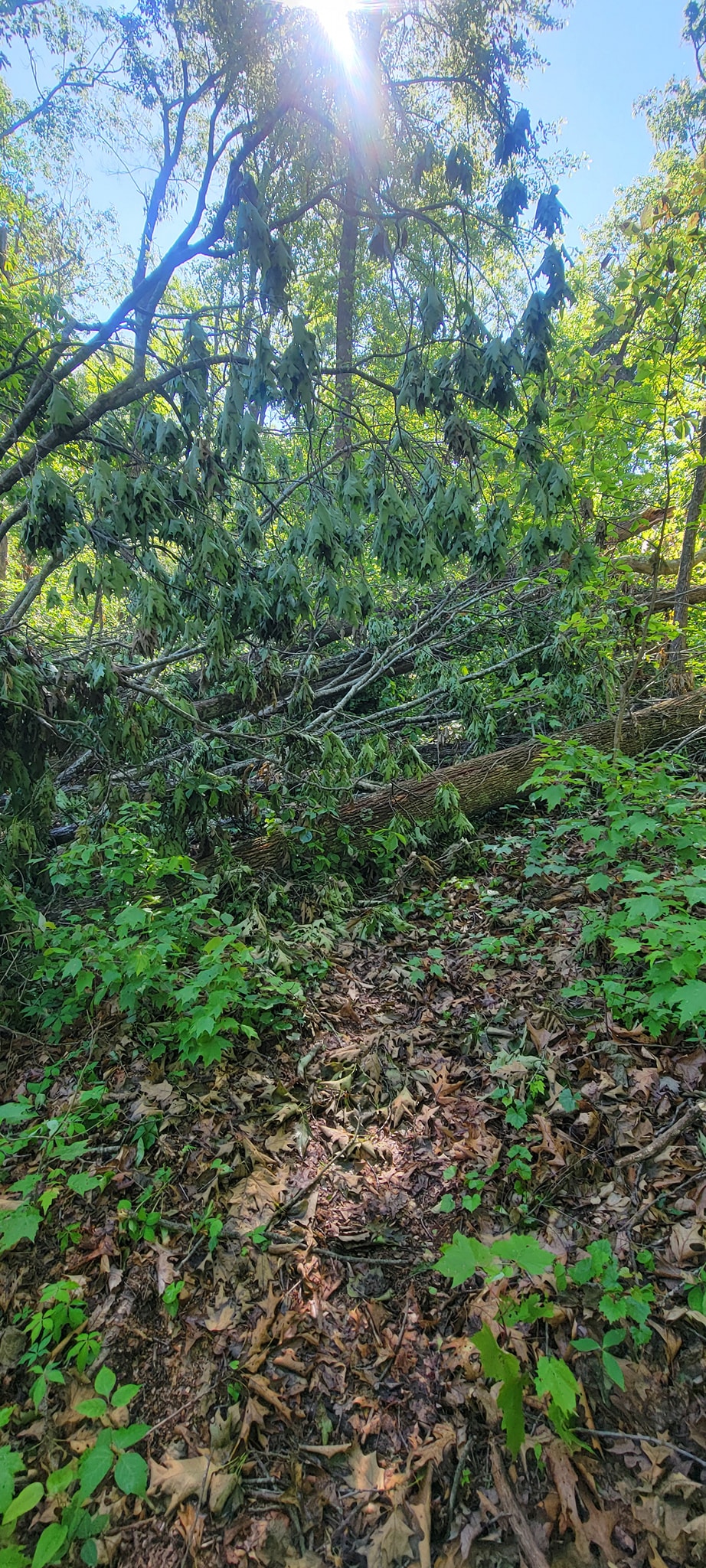 Contributed photo / The Benton MacKaye Trail, pictured here in May, is completely hidden by trees felled by storms that passed through the area since April. The Benton MacKaye Trail Association, based in Cherry Log, Ga., has led crews of volunteers to remove hundreds of trees felled across the trail in the Cherokee National Forest.