
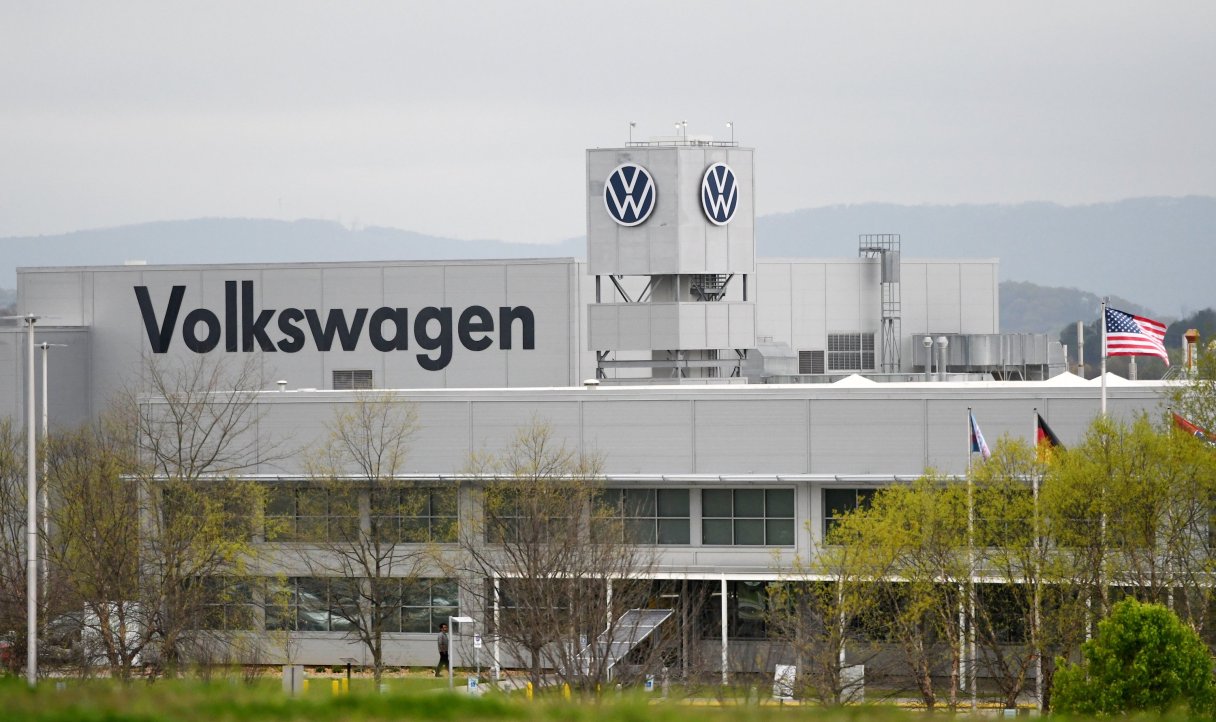
President Donald Trump’s tariffs will “almost assuredly” increase the price of used and new cars, an industry analyst said, which comes as Volkswagen mulls a fee on imported vehicles sold in the United States, according to reports.
The German automaker told dealers in an April 1 memo that the exact fees would be determined by the middle of the month, according to reporting from The New York Times.
The company halted rail shipments of cars to the United States from its plants in Mexico, although shipments by sea continue, and it plans to hold cars that are subject to tariffs in port for the near term, The New York Times reported. The price of the Volkswagen Atlas, which is made in Chattanooga, could also be affected by the tariffs, the paper reported.
(READ MORE: Sweeping Trump tariffs shock global economy, drawing threats and calls for talks)
As part of a larger effort to bring manufacturing back to the U.S. and clamp down on what he calls unfair trade practices by other nations, Trump this week imposed a 25% trade penalty on all imports of passenger cars and light commercial vehicles. In the future, the White House also plans to place a 25% tariff on imported car parts.
In a statement, Volkswagen said it communicates with its dealers about all aspects of the business and wants to be transparent as it navigates through this time of uncertainty. The situation is fluid, and the company hasn’t made any final decisions about how it would adjust its business.
“The messaging can change daily, based on circumstances,” the company’s statement said. “We have our dealers’ and customers’ best interest at heart, and once we have quantified the impact on the business, we will share our strategy with our dealers.”
The Volkswagen Group has said the United States is an important market for the company, noting it has recently invested more than $14 billion and supported thousands of well-paid jobs.
“We share the assessment of most experts that U.S. tariffs and any counter-tariffs will have negative consequences for growth and prosperity in the U.S. and other economic areas,” a spokesperson said. “The entire automotive industry, global supply chains and companies as well as customers will have to bear the negative consequences.”
The company continues to promote a “rules-based” exchange of goods, open markets and stable trade relations. Those are essential for a competitive economy and particularly the automotive industry, the company said.
“At the same time, we continue to advocate constructive talks between the trading partners in order to ensure planning security and economic stability and to avoid a trade conflict,” the company said.
Volkswagen employs about 5,500 people in Chattanooga, where it builds the Atlas and Atlas Cross Sport SUVs. It also assembles the ID.4 electric SUV.
The company is continuing to negotiate with the United Auto Workers on a contract. Those negotiations continue almost a year after a majority of workers voted to join the union. In March, the company announced it would return primarily to a two-shift production schedule at the plant, saying it has underutilized capacity and will offer voluntary buyouts to cut its workforce.
Karl Brauer, executive analyst at iSeeCars.com, said a spike in new car prices typically increases demand for used automobiles, which in turn boosts the cost of secondhand vehicles.
“Both new and used car prices will almost certainly go up, by and large, as a result of these tariffs,” he said in a phone call.
Trump’s trade penalties are requiring all automakers to reevaluate the cost structure for all the cars they produce, Brauer said. Even if companies assemble their vehicles in the United States, automakers largely rely on components from overseas.
Honda intends to produce its next generation Civic hybrid in the United States instead of Mexico in an effort to avoid tariffs, according to Reuters.
With there being some unpredictability about how long the trade penalties will last, companies have to determine whether it’s worth making large, systemic changes in their business as opposed to more simple adjustments, such as an import fee.
“Adding more to the cost of the car, which is effectively what they’re doing, is the easiest thing for automakers to do,” Brauer said. “They can all just slap 25% higher (suggested prices) on all their vehicles and not do anything else, and they’d be theoretically exactly where they were before the tariffs.”
However, most automakers won’t do that, Brauer said. They’ll figure out how to absorb that 25% without passing it on to the consumer.
“The ones that do that most successfully and can maintain lower prices in this new atmosphere will get more sales,” he said.
Contact David Floyd at dfloyd@timesfreepress.com or 423-757-6249.