
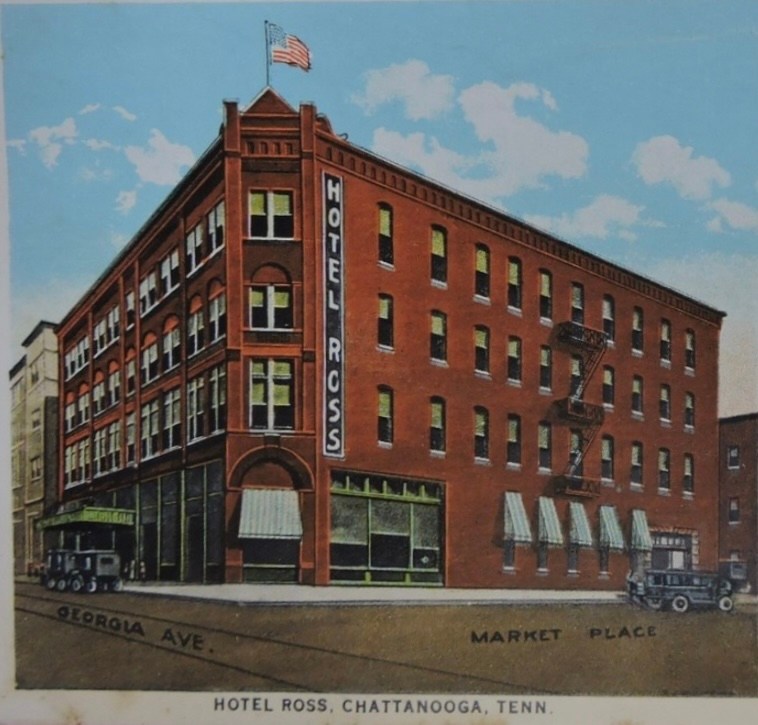
On Saturday, Jan. 10, 1925, A.W. Lessly filed for a charter with the Hamilton County Court clerk’s office for the Ross Operating Company. The proposed Hotel Ross would be located in an existing building at the corner of Georgia Avenue and Market Square in downtown Chattanooga. Lessly supervised renovations, working closely with the architects and construction crews on new features that were designed to attract both visitors to the city and local residents planning special events. An investment of more than $250,000 had been made; renovations were estimated to cost $100,000. Work began on the structure in early fall 1924. The hotel was scheduled to be ready before the 1925 summer travel season.
Three months later, on April 2, Hotel Ross opened its doors to “hundreds of Chattanoogans” with a “grand reception.” The Chattanooga Daily Times reported, “In the Ross, Chattanooga has a hotel that, in convenience, comfort and elaborate furnishings, will vie with any of the modern hotels. Seventy rooms, each with an adjoining bath, is its capacity.” Businessman O.B. Andrews Jr. registered as the hotel’s first guest.
Music filled the air as two orchestras played throughout the afternoon and early evening. Later in the evening, the Syncopators performed dance pieces in the stylish basement “grotto,” which held 200 people. On an upper floor, Mrs. H.P. Manning of the Tivoli musical staff sat at a magnificent rosewood grand piano, offering classical favorites.
Guests shared comments about the impressive decor as they wandered through the hotel, which was named for Chief John Ross, the longest-serving principal chief in the history of the Cherokee Nation. The spacious lobby featured overstuffed furniture. The stucco walls held a series of large oil paintings of Chattanooga, depicting subjects ranging from the days of the Civil War to current times. A prominently displayed painting of Moccasin Bend as seen from Lookout Mountain drew crowds and an occasional round of applause.
Off the lobby was an attractive, soon-to-open coffee room furnished for casual conversations and food. Other spaces, already open, included a barber shop, manicure rooms and clothing shops.