
Thursday, October 29, 2026Oct 29

This story is free to read.

Opinion: Weakened Iran could be open for improved deal

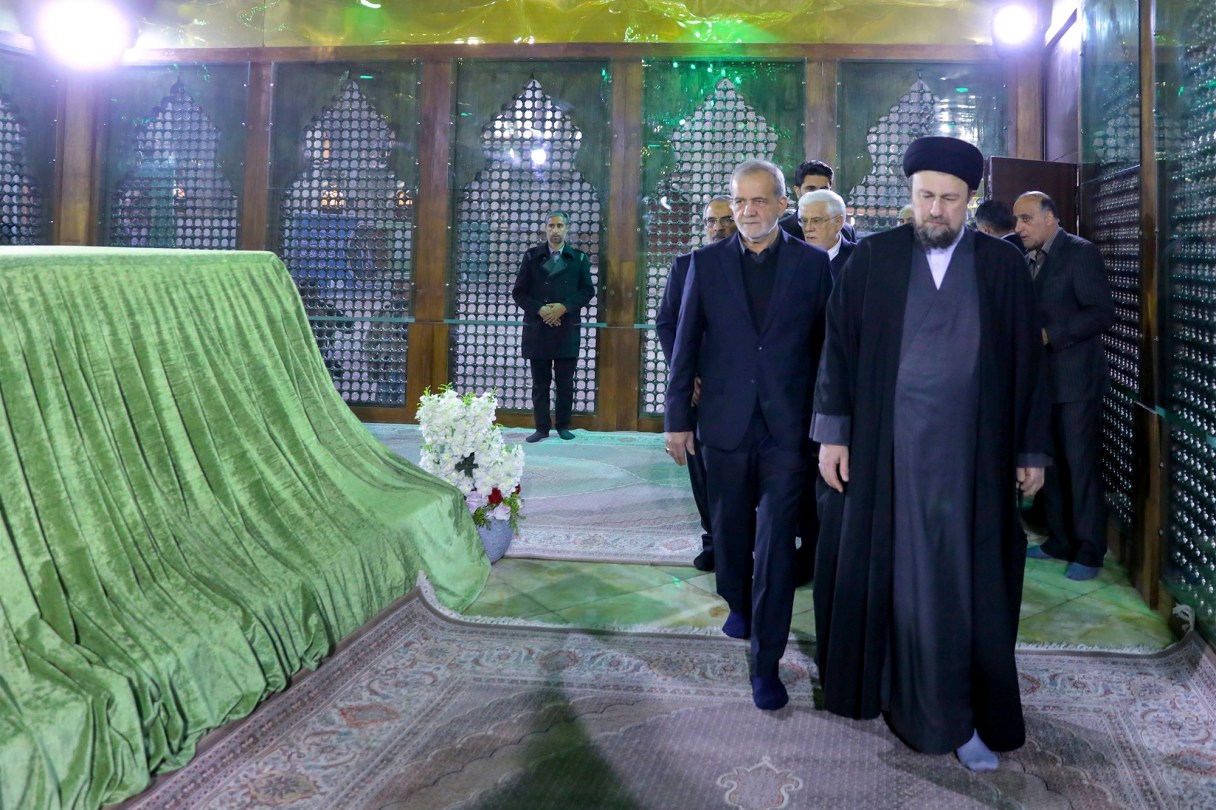
Photo/Iranian Presidency Office via The Associated Press / In this photo released by the Iranian Presidency Office, President Masoud Pezeshkian, left, visits the grave of the late revolutionary founder Ayatollah Khomeini, commemorating anniversary of his return from exile after 14 years during the 1979 Islamic Revolution, as he is accompanied by Khomeini's grandson, Hassan, just outside Tehran, Iran, on Saturday, Feb. 1, 2025.
Photo/Iranian Presidency Office via The Associated Press / In this photo released by the Iranian Presidency Office, President Masoud Pezeshkian, left, visits the grave of the late revolutionary founder Ayatollah Khomeini, commemorating anniversary of his return from exile after 14 years during the 1979 Islamic Revolution, as he is accompanied by Khomeini's grandson, Hassan, just outside Tehran, Iran, on Saturday, Feb. 1, 2025. Photo/Iranian Presidency Office via The Associated Press / In this photo released by the Iranian Presidency Office, President Masoud Pezeshkian, left, visits the grave of the late revolutionary founder Ayatollah Khomeini, commemorating anniversary of his return from exile after 14 years during the 1979 Islamic Revolution, as he is accompanied by Khomeini's grandson, Hassan, just outside Tehran, Iran, on Saturday, Feb. 1, 2025.

President Donald Trump has wisely muted his boasts of ending the Ukraine war in a day. His peacemaking energies might be better diverted to another intractable conflict: the U.S. standoff with Iran.

Iran, the main U.S. adversary in the Middle East, is weaker than it’s been in decades. A high inflation rate, a plummeting currency, capital outflows and lack of investment have hollowed out the economy. A brutal crackdown on protesters has enraged ordinary citizens.

Most importantly, Israel has literally blown up Tehran’s strategy of using proxies such as Hamas and Hezbollah as a first line of defense. Israeli strikes have dismantled key air defenses, exposing critical installations to attack.

Some in Trump’s orbit argue that the U.S. and Israel should seize this opportunity to bomb Iranian nuclear facilities and possibly topple the regime. They’re correct that Iran has enough fissile material to make a dozen bombs already and growing incentive to weaponize it.

Yet the arguments against military action remain as strong as ever. A strike would be hugely complex and challenging. Even stripped of defenses, facilities buried deep underground will be hard to destroy. Any gains would be temporary, while an attack is as likely to spur Iranians to rally around the government as to overthrow it. Whatever regime emerges could well be even more radical and obdurate.