

Business leaders are used to making tough decisions. Who should be hired? What’s the best way to innovate? Which investments make the most sense?
Now, however, artificial intelligence (AI) is being used to sort through complex data, detect trends and even begin suggesting next steps.
And while it may be incredibly efficient in many ways, it’s not without challenges and concerns, which raises a new question: When it comes to leadership, how much authority be handed over to AI?
PARTNER, TOOL OR COMPETITOR?
Imagine you’re attending a video conference where you’re sharing ideas with a room full of 20 other humans. At the end of the meeting, you find out that one of those humans isn’t human. It’s an “AI persona” — a programmed collection of behaviors and decision-making patterns — intentionally placed in the meeting to help “fill in the gaps” for company knowledge that humans are missing.
This kind of technology is already in use at large companies, says Deborah Duncan, president of the Southeast Tennessee Society for Human Resource Management chapter.
She says most companies rely on AI for research, repetition and rote tasks, and Human Resources (HR) is a prime example. Large companies often receive hundreds of daily calls about benefits, even though the answers are already available online. AI-powered “Ask HR” chatbots now respond instantly, reducing repetitive work.

“That’s an efficient use of AI — but not exactly decision-making,” Duncan says. Early AI platforms focused on “narrow” tasks: specialized, strictly-defined functions rather than general problem-solving. But everyday tools such as ChatGPT and Perplexity are beginning to anticipate user needs, refine prompts and even suggest conclusions.
“That scares people,” Duncan says. “The argument is that AI doesn’t understand human emotions or context. But human reactions themselves are just a set of behaviors, and those can be mimicked. In business, where decisions are supposed to be logical and comprehensive, AGI can absolutely do that.”
Beyond “narrow AI” is “agentic AI” — the realm where things like “digital personas” exist. The level beyond that, Duncan explains, is evolving into “autonomous generative AI,” which is able to process information independently and reach conclusions on its own.
“This isn’t just a tool anymore,” she says. “It’s a collaborator, or maybe even a competitor.”
She points to nationally known dating coach and author, Matthew Hussey, who trained an AI version of himself — “Matthew AI” — on nearly two decades of talks and writings. The result: a digital persona that answers questions exactly as he would.
“If companies can do that with executives, why pay one person when you can buy an agent with the collective knowledge of hundreds?” Duncan asks. “From a business perspective, it makes sense. From a career perspective, it’s a huge concern.
“The question isn’t whether AI will reshape business. It’s how soon — and whether we’re ready for the consequences.”
FAR FROM FLAWLESS
We are in ‘The Year of Agentic AI,” says Beni Asllani, Rollins Professor of AI and Department Head of Data Analytics at the University of Tennessee at Chattanooga. And that evolution, he says, holds both benefits and risks for business.
“More than 50% of companies are implementing AI in their business operations every day,” Asllani says. “I’m expecting next year it will be 70%. In a couple of years, 90% of companies will be using AI.”
Fast data processing and improved prediction are two of AI’s most obvious benefits.
“AI processes large amounts of data in a much shorter amount of time than humans,” Asllani says. “That leads to better and faster decisions that are driven by data rather than intuition or experience. AI is good for prediction — recognizing patterns, spotting trends, detecting fraud, optimizing delivery. At the bottom line, AI can be used as an optimization tool.”

And, unlike humans, AI doesn’t need breaks or down time.
“Managers and leaders work eight hours a day. Now, with an agent AI, you can actually reply 24/7. Leaders sometimes get tired or distracted. AI is never tired, never distracted. It provides consistency that human judgment doesn’t always have.”
Still, Asllani emphasizes that AI is far from flawless.
“Bias is one thing,” he says. “AI is going to be as good as the data. Algorithms learn from historical data, and if the data have bias, then the AI will spill it out. There are examples where AI used in hiring may show bias toward gender or race.”
The difference in national and local university data makes a great example, he adds.
“We could create an AI system for our students, but those algorithms are trained on national student demographics. UTC is a little bit different — we have more first-generation students, we have a different gender structure. So we may come up with suggestions that may be good for Harvard or some other big schools, but not good for our students.”
Then there is “the black box problem,” he says, referring to the puzzling nature of AI that even designers don’t fully understand how the algorithms arrive at their outputs. Guidelines can be provided, then the AI takes over and, ultimately, leaders are left trusting the system and hoping it delivers the right outcome.
“AI is data-driven,” Asllani says. “Unlike other technologies, once your information is used to train the algorithm, you cannot really get out. You can say, ‘Don’t use my data anymore,’ but it doesn’t matter because they already trained the model with your information.”
Despite all the risks, Asllani remains confident that AI will never fully replace people in decision-making.
“AI dramatically improves the decision-making process through faster data processing and accuracy,” he says. “But we need oversight. Without oversight, AI can enforce bias and lead to decisions that are hard to explain.
“AI is a partner in decision-making, not a replacement of humans.”
‘NEXT NATURAL STEP’
AI touches nearly every part of operations at FreightWaves and Firecrown media companies, says founder and CEO Craig Fuller. To him, it’s the next natural next step in business technology.
He rattles off a fast list of all the tasks the companies use it for: ideation, copy editing, SEO optimization, transcribing video and podcast episodes, reporters using it to help structure complicated content. Its benefits are clear: efficiency, cost savings and speed.
Between the two companies, he says, they take in about 1,000 pieces of contributed content a month across 40 different titles — and that creates extensive amounts of administrative work.
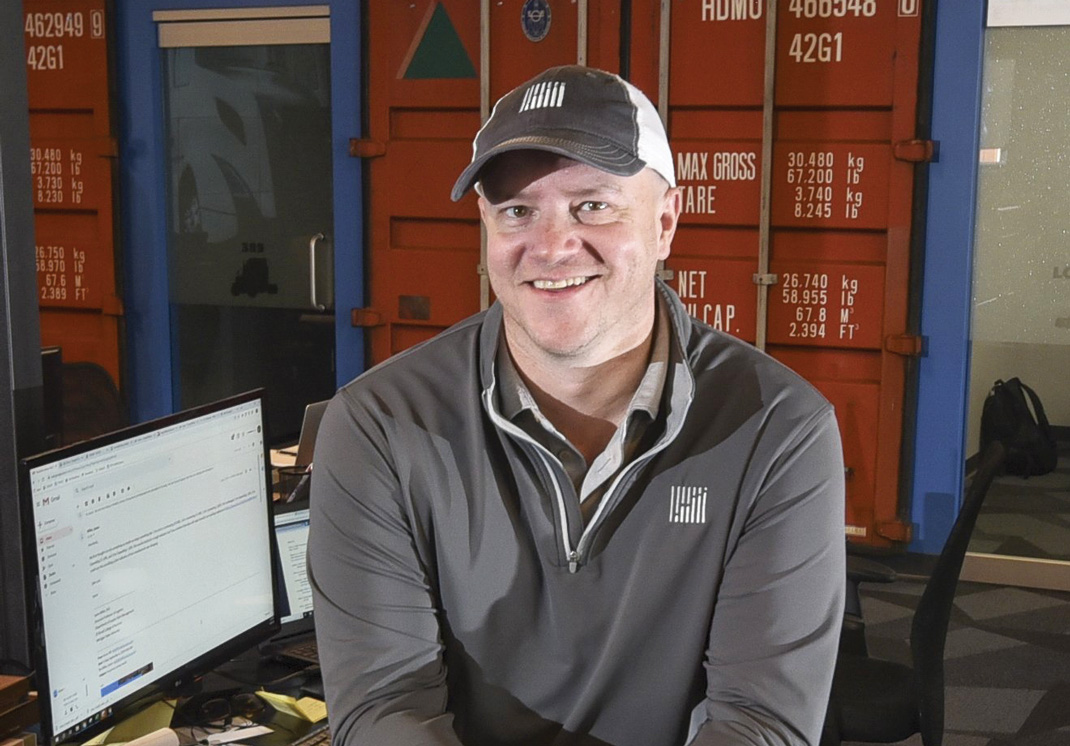
At one point, he says, the companies were looking at software options from about eight different vendors, each with options that could solve some, but not all, of the problems at hand. But ultimately, their chief technology officer was able to use AI to develop a product within days — an internal application that can track contributors and manage the workflow all the way through to payment.
In fact, Fuller says he used AI to help finish his upcoming book, “Moving the World,” about the evolution of supply chains, due to be released at the beginning of October. Working with a human editor was time consuming, he says, and was laborious in terms of communicating complicated industry-specific subjects, whereas AI can easily access that language.
Still, he cautions, he would never trust AI to do the work on its own. The result of that would be “big trouble.”
“It will never … replace the human intellect,” he says. “It gets things wrong. It hallucinates. It sometimes makes up facts. Left to its own devices, it’s not trustworthy. That’s why you still need human oversight.”
Fuller also acknowledges the potential for AI to displace entry-level jobs, but says efficiency and cost savings make it too valuable for business owners to ignore.
“Technology is going to make it cheaper for competitors to create content,” he says. “The only way we can win is to adapt the same technology — while keeping humans driving the process.”

At Wacker Chemie, a major chemical manufacturer and one of the largest employers in Bradley County, Tennessee, AI is a growing tool in both administrative and production processes.
Raj Polanki, senior director of technology, says business-grade AI is being used to help employees write and summarize text, reducing manual work and minimize errors. AI also analyzes production data to improve efficiency, predict equipment maintenance and enhance quality.
“Integrating AI into our operations has supported safer, more efficient and more reliable production,” he says.
Still, he says, like many companies, Wacker recognizes both the opportunities and challenges that come with using the evolving technology.
“We view AI as a tool to support — not replace — human expertise,” Polanki says. Routine, data-driven processes can be automated, but critical thinking and contextual decisions remain in human hands.
Looking ahead, he says Wacker expects to expand AI in areas like advanced manufacturing, supply chain optimization and research and development, while remaining cautious.
NOTE: This story was updated on Oct. 13 to correct Beni Asllani’s title with the University of Tennessee at Chattanooga.
* How communication and lifelong learning unlock career advancement
* Bruce’s journey to become first female chancellor of UTC
* Leadership secrets from Chattanooga’s most successful executives