
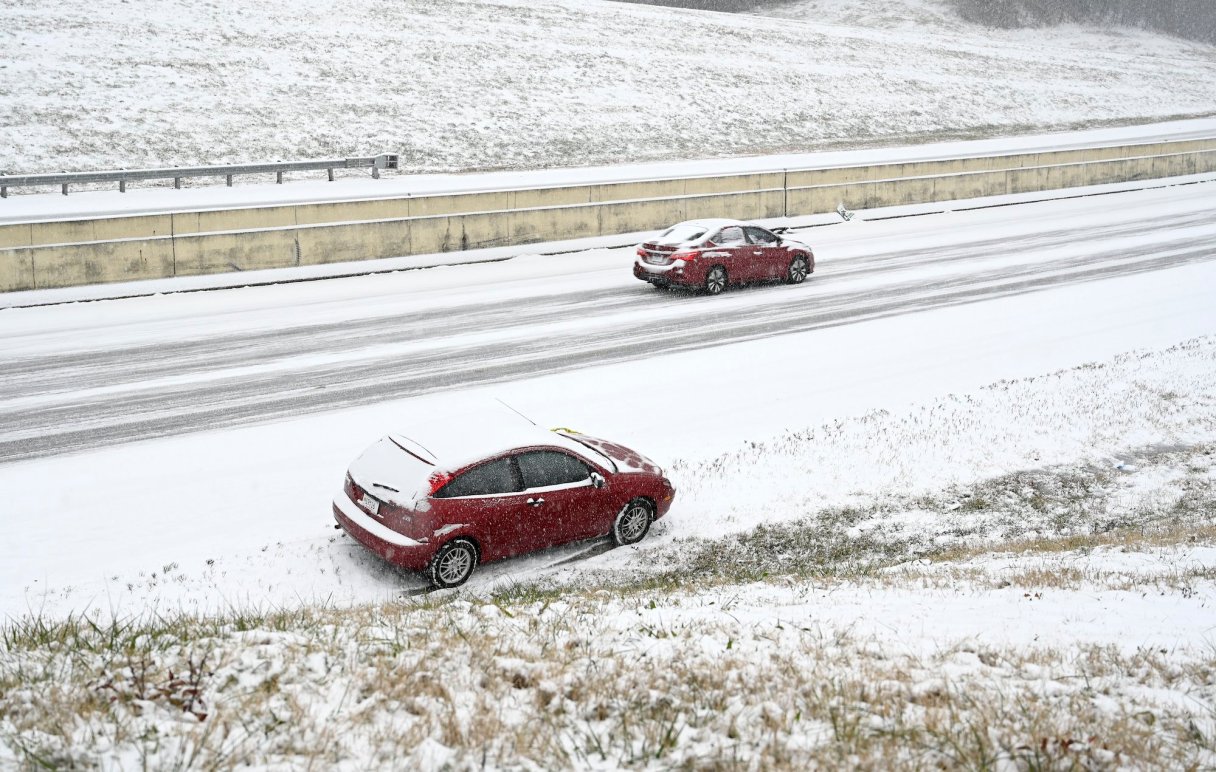
State officials in Tennessee and Georgia are urging people to stay off the roads Friday and Saturday amid a winter storm watch, but if you must, the National Highway Traffic Safety Administration has these tips for safer winter travel.
Before you go, stock your vehicle with items to handle common winter driving-related tasks and supplies for emergencies, including:
— A snow shovel, broom and ice scraper
— Abrasive material, such as sand or kitty litter, in case the vehicle gets stuck in the snow
— Jumper cables, flashlight and warning devices such as flares and emergency markers
— First aid kit, including a tourniquet
— Blankets for protection from the cold
— Cell phone and charger, water, food and necessary medicine
Gas it up or plug it in
— Keep your gas tank close to full whenever possible.
— For electric and hybrid-electric vehicles, keep your battery charged and minimize the drain on the battery. In general, batteries with liquid electrolytes have reduced energy storage and delivery capabilities at lower temperatures, which is why most vehicle batteries use battery power for self-heating in low temperatures. The battery drain due to heating can be minimized by keeping your electric vehicle as warm as possible during freezing temperatures. A common way to do this is by plugging your vehicle in at night during the winter — keeping the battery in its optimal temperature range.
Plan your route
— Check your local weather and traffic reports before heading out. If roads are not in good shape, consider postponing non-essential travel until the roads are cleared. If you have to go out, be prepared for delays while traveling, and familiarize yourself with directions and maps before you go — even if you use a GPS — and let others know your route and anticipated arrival time. On longer trips, plan enough time to stop to stretch, get something to eat, check your phone and change drivers or rest if you feel drowsy.
(READ MORE: Cold is coming, Chattanooga. Here’s how to prepare your pipes)
The Tennessee Department of Transportation said in a press release Wednesday that it was stocked and ready for inclement weather throughout the state. The department also has tips for safer driving in the winter:
Reduce your speed
— When it snows, use your head, not your feet. Slow down for wet, snowy or icy conditions; when visibility is poor; or when conditions are changing or unpredictable — no matter what type of vehicle you drive. Even an SUV with four-wheel drive may not be able to stop any faster, or maintain control any better, once you lose traction.
— Slow down when approaching intersections, off-ramps, bridges or shady spots. These are all candidates for developing black ice — a thin coating of clear ice that can form on the pavement surface that may be difficult to see.
— Avoid excessive actions while steering, braking or accelerating to lessen the chances of losing control of the vehicle.
— Space out. Leave plenty of room between your vehicle and others. It takes more time and distance to stop your vehicle in adverse weather conditions, so use your brakes carefully. Brake early, brake slowly, brake correctly, and never slam on the brakes.
(SIGN UP: Get breaking news in your inbox as it happens by going to timesfreepress.com/breaking)
No cruising
— Avoid using cruise control in winter driving conditions. You need to be in control of your speed based on road conditions — don’t let the cruise control make a bad decision for you.
— Remember: Winter conditions call for different driving tactics. Ice and snow, take it slow — slower speed, slower acceleration, slower steering and slower braking.
Safe travel around snowplows
— Don’t crowd the plow. Snowplows plow far and wide — sometimes very wide. The front plow extends several feet in front of the truck and may cross the centerline and shoulders during plowing operations. Plows also turn and exit the road frequently.
— Don’t tailgate or stop too close behind snowplows. Snowplows are usually spreading de-icing materials from the back of the truck, and those materials can damage vehicle paint. Plows also may need to stop or take evasive action to avoid stranded vehicles. If you find yourself behind a snowplow, stay behind it or use caution when passing. The road behind a snowplow will be safer to drive on.
— On multiple lane roads, watch for snowplows operating in either lane. Snowplows travel much slower than the posted speeds while removing snow and ice from the roads. When you spot a plow, allow plenty of time to slow down.
— A snowplow operator’s field of vision is restricted. You may see them, but they may not see you.
Be prepared
— Before leaving home, find out about the driving conditions by calling 511 from any land line or cellular phone or visiting tn511.com. Safe drivers know the weather, and they know their limits. If the weather is bad, remember, ice and snow, take it slow, or just don’t go.
— Before venturing out onto snowy roadways, make sure you’ve cleared the snow off all of your vehicle’s windows and lights, including brake lights and turn signals. Make sure you can see and be seen. Always buckle up.
— Give yourself extra time to reach your destination safely.
— Winter conditions can be taxing on your vehicle. Check your vehicle’s tires, brakes, fluids, wiper blades, lights, belts and hoses to make sure they’re in good condition before the start of the winter season. A breakdown is bad on a good day and can be dangerous on a bad-weather day.
Driving maneuvers
— Stopping on snow and ice without skidding requires extra time and distance. If you have anti-lock brakes, press the pedal down firmly and hold it. If you don’t have anti-lock brakes, gently pump the pedal. Either way, give yourself plenty of room to stop.
— When you’re driving on snow, accelerate gradually.
— When you’re driving on snow, ice or wet roads, avoid abrupt steering maneuvers.
— When you’re driving on snow, ice or wet roads, merge slowly, since sudden movements can cause your vehicle to slide.
— When driving in adverse road conditions, look farther ahead in traffic than you normally do. Actions by other vehicles will alert you to problems more quickly, and give you that split-second of extra time to react safely.
— Compiled by Ben Benton