
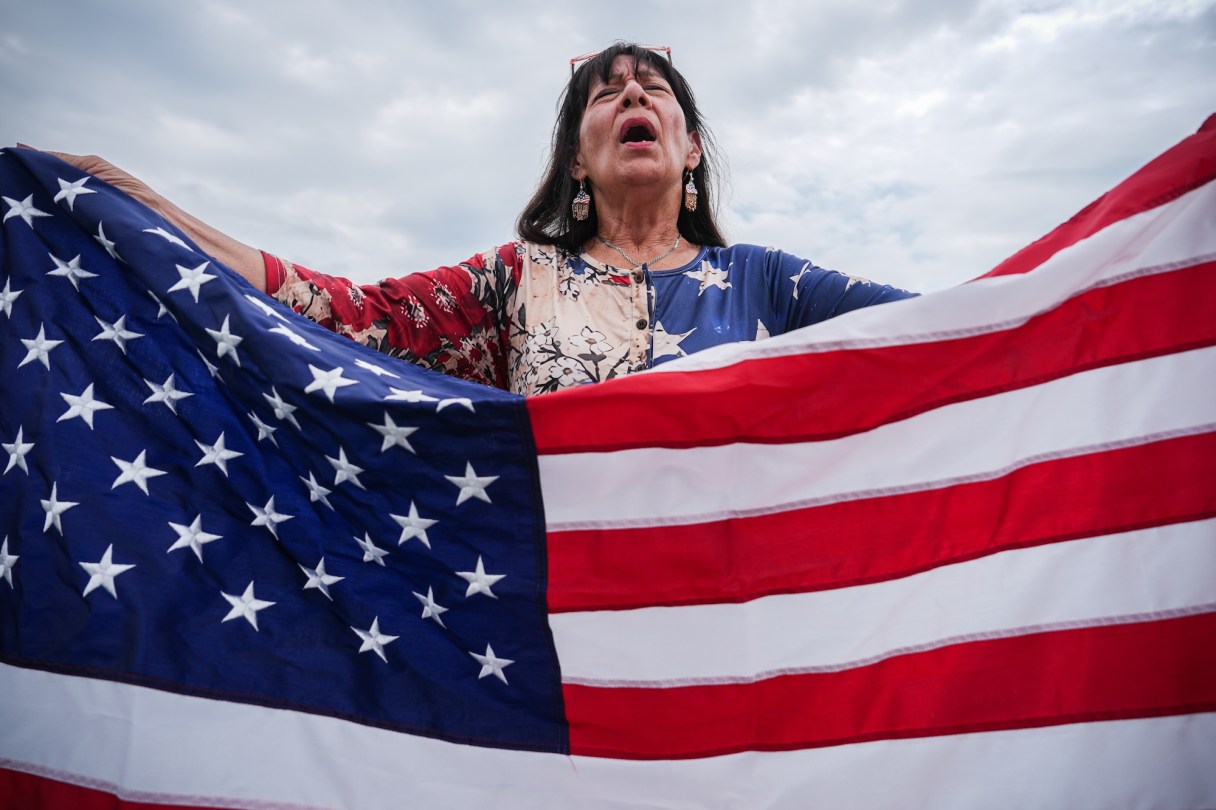
One month short of America’s 250th birthday, it’s clear we won’t be getting an extravagant and unifying celebration of American greatness and patriotism. So maybe the best we can hope for is a healthy debate about the nature of American identity, which might lay a foundation for a more splendid celebration come 2076.
Throughout the Trump era, the what-is-America debate has often pitted a creedal vision of national identity rooted in allegiance to certain ideals — and thus immediately available to any new-arriving immigrant — against a cultural nationalism that emphasizes ancestral heritage. Apostles of the creedal conception often cast themselves as defenders of an embattled center, menaced by an anti-patriotic left and an ethnically or religiously chauvinist right.
Recent essays by The Atlantic’s Yoni Appelbaum and Substacker Noah Smith stand as useful exemplars of this creed-as-centrism perspective. And in polling, the creedal perspective does seem much more unifying.
Smith’s essay cites a July 2025 survey showing that “supporting the U.S. Constitution” and “believing in the principles of the Declaration of Independence” are treated as fundamental markers of American-ness by large majorities of both political coalitions. Not even a majority of Republicans identify being born in the U.S., speaking English or “having many generations of American ancestors” as essential. “Being white,” meanwhile, polls at 2% of Democrats and 8% of Republicans.
It’s hard to see a promising future for the more exclusivist understandings of American identity, whether they ground themselves on an attenuated Anglo-Protestant inheritance, a hazily defined “white culture” or an invented “heritage American” category. Those often exist in a dynamic interaction with identity politics on the left, without offering a stable ground for the America that actually exists today.