
Public records requests sent to 35 state and local governments and agencies in the Chattanooga area reveal that officials at more than a dozen use generative artificial intelligence for work.
Reporters at the Chattanooga Times Free Press submitted the requests for AI chat logs from a handful of officials at each of the 35 governments and agencies in Tennessee and Northwest Georgia.
With the emergence of the new technology, access to related public records becomes more important, said Deborah Fisher, executive director of the Tennessee Coalition for Open Government.
“We need to keep an eye on how government is using AI, and how AI is using government,” Fisher said by phone. “In other words, we need to understand the influence of AI on government decisions.”
A good way to do that, Fisher said, is by ensuring the public has access to related public records.
Generative artificial intelligence, the ability of computer systems or algorithms to imitate intelligent human behavior, is capable of quickly processing and analyzing vast quantities of data and has the potential to transform industries from education to medicine.
‘TRANSITORY NATURE’
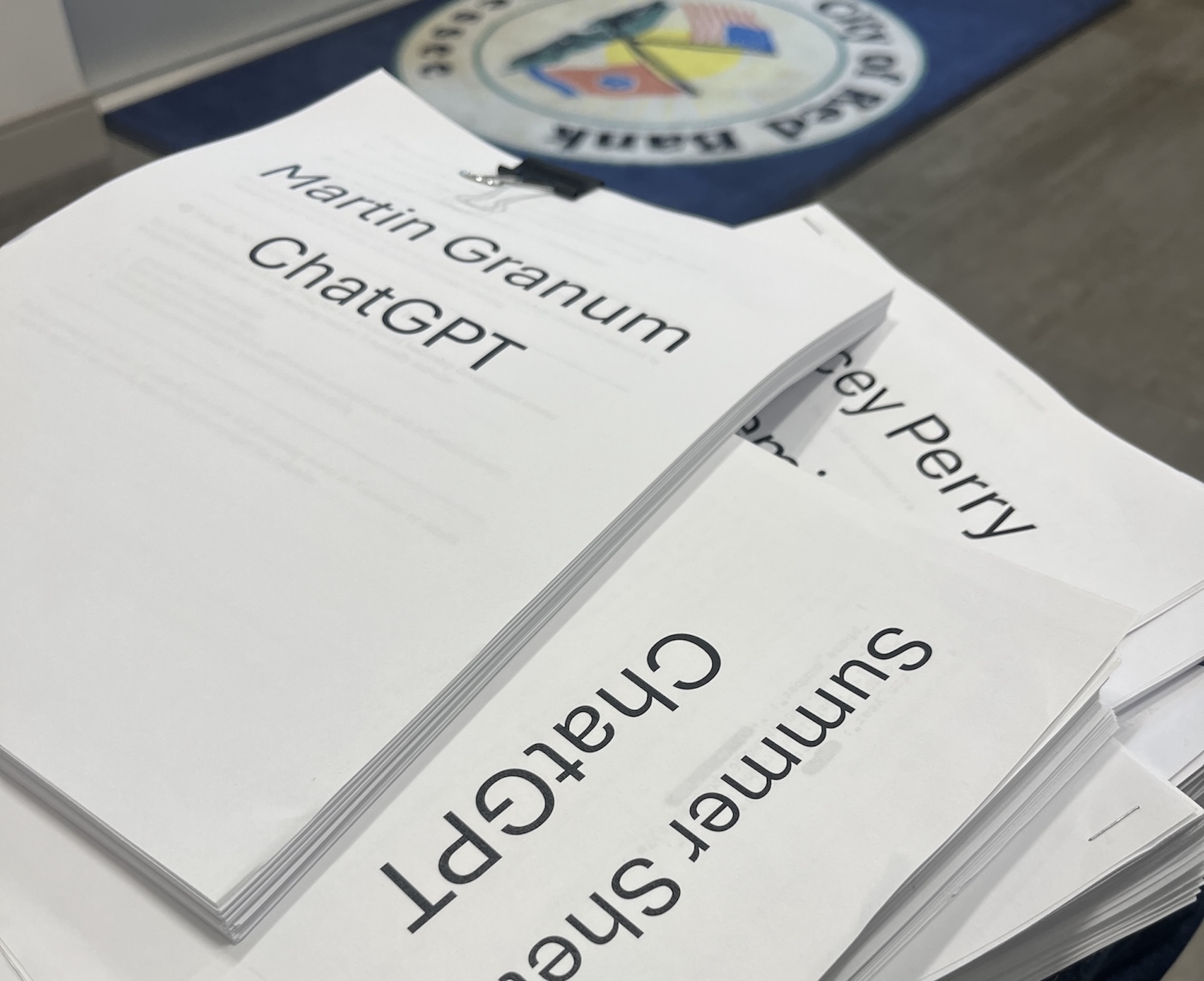
Of the government organizations that received requests, 13 released records of chat logs.
In one instance, the city manager in Red Bank, Martin Granum, used AI to assist with writing a policy governing the use of the technology. The city’s Board of Commissioners approved Granum’s policy Tuesday.
Few governments and agencies in the region have established guardrails to direct state and local officials’ use of the technology, a report published Friday revealed.
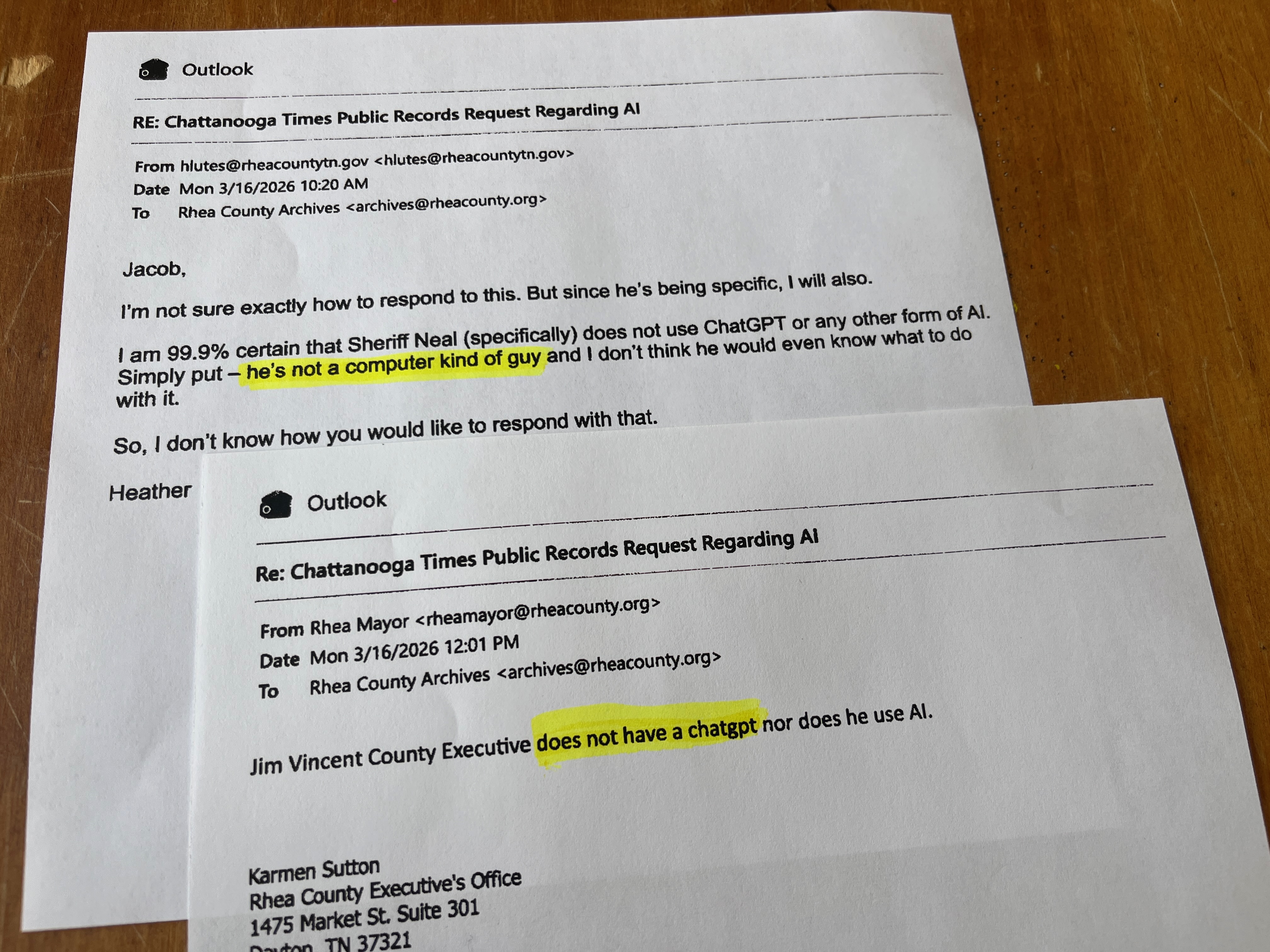
Eleven of the organizations said the officials named in the requests had not used AI and had no chat log records. Hamilton County said Mayor Weston Wamp did use ChatGPT, but for personal matters, and said they were exempt from disclosure.
SUNSHINE WEEK
The Chattanooga Times Free Press this month made dozens of document requests for artificial intelligence policies and chat logs from state agencies and local governments to mark Sunshine Week. This national, nonpartisan collaboration of journalists, civic educators, government officials and businesses highlights the need for open government and freedom of information.
Reporters requested records from government offices, including state-level departments; city, town and county governments in Southeast Tennessee and Northwest Georgia; five local agencies; three law enforcement agencies; and the Tennessee Valley Authority — a federal agency that operates in the region.
This story is the second of several that will examine policies, AI use and compliance with public records laws at governments in the region.
“I am 99.9% certain that Sheriff Neal (specifically) does not use ChatGPT or any other form of Al,” Heather Lutes, a Rhea County Sheriff’s Office employee, said in an email responding to a request for Sheriff Mike Neal’s chat histories. “Put simply — he’s not a computer kind of guy, and I don’t think he would even know what to do with it.”
The Tennessee Corrections Institute, which also said it did not have responsive records, initially responded that it would need to check with the IT department because exporting AI chats was not something they’d ever been asked to do before.
The city of Fort Oglethorpe and five Tennessee state agencies, including the Tennessee Department of Children’s Services and the secretary of state, have not yet fulfilled the request, saying they need more time.
TennCare estimated a response time of more than a month. It had not produced documents or denied the request at the time of publication.
Tennessee’s open records law requires a response within seven working days, but agencies can request reasonable extensions if records are not easily accessible.
Georgia law requires a response within three days and has similar provisions for extensions.
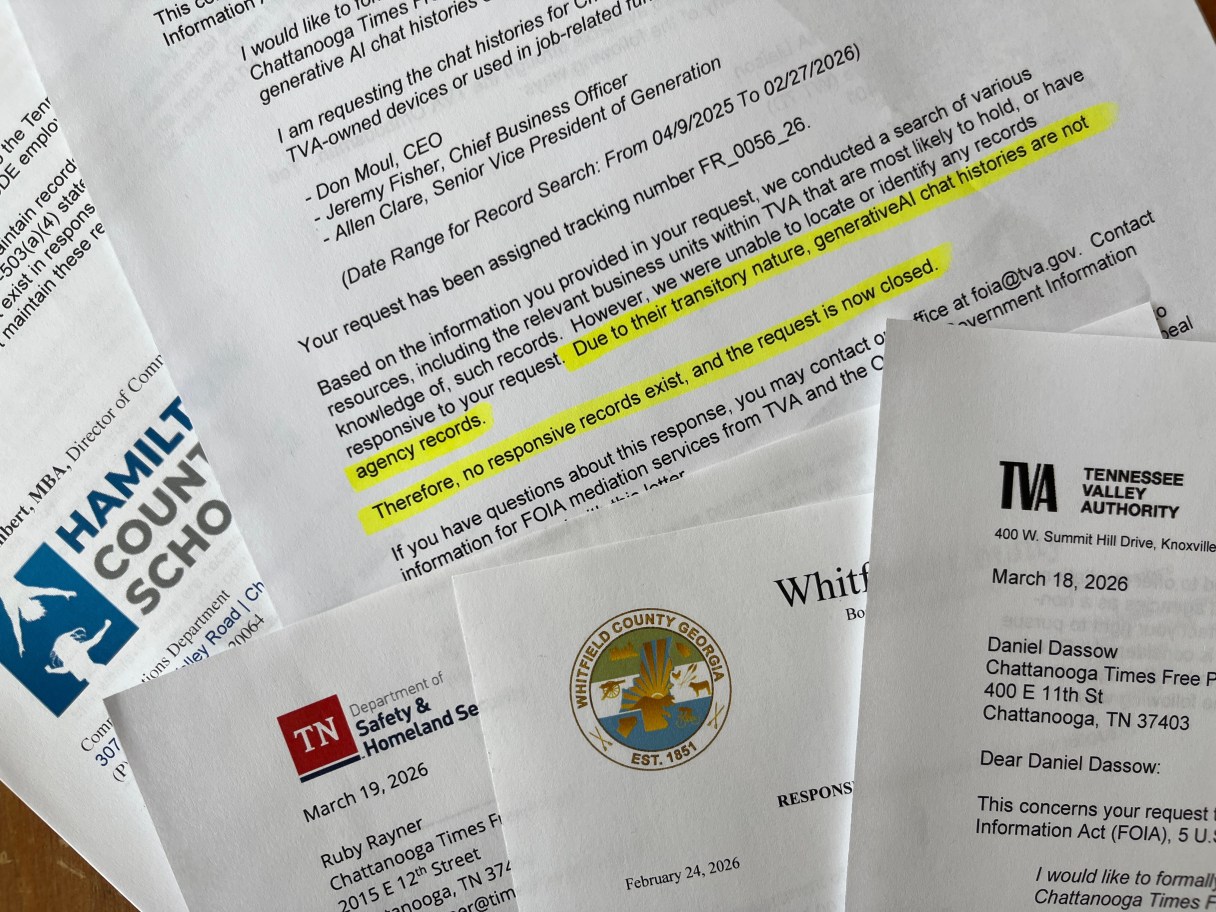
Five government organizations denied the Times Free Press’ requests for AI chat log histories.
The Tennessee Valley Authority said in an email that it was unable to identify responsive records and added, “Due to their transitory nature, generative AI chat histories are not agency records.”
The federal regional utility outlined a process to appeal the decision, which the Times Free Press plans to do.
(SIGN UP: Get Chattanooga area politics news weekly in your inbox at timesfreepress.com/politics)
Whitfield County denied the request, saying it would be difficult to track down chats for some of the five AI models named in the request — ChatGPT, Copilot, Claude, Grok and Gemini.
“The department can show which computers have Copilot and ChatGPT, but the other AI programs are used online, which will be next to impossible to determine who has used them,” a note from the county IT department included in an emailed response to the request said.
The 35 requests do not count an additional five governments and agencies, including the cities of Chattanooga and Cleveland, that still have time to respond to requests before an initial response deadline is reached.
The requests are part of Sunshine Week, a national, nonpartisan effort by journalists, civic educators, government officials and businesses to draw attention to the role of public records in ensuring freedom of information and open governments.
The transparency efforts come as the second administration of President Donald Trump removes data from government websites, shrinks the workforce of a government accountability office and as federal record request backlogs have reached an all-time high.
OPEN RECORD IMPACT
Stories based on open records can have an impact.
Last year, Hamilton County officials canceled plans to rezone part of a beloved park for industrial development after public pushback. Internal communications, released to the Times Free Press by the county after more than eight months of delay, foreshadowed the plans before they were finalized.
In June 2024, former Chattanooga Police Chief Celeste Murphy was indicted on multiple charges, including forgery and perjury. Murphy’s resignation and indictment followed reporting by the Times Free Press that Murphy had put conflicting information on employment forms, voting forms and property tax documents, many of which were signed under penalty of perjury.
In 2019 and 2020, the Times Free Press went head-to-head with Hamilton County Attorney’s Office over the release of public records that were destroyed, leading state legislators from the county, including Sen. Todd Gardenhire, R-Chattanooga, to pass a law that prohibits the destruction of records, requires stricter records maintenance and imposes fines for violators.
“We had a bad experience with the past county attorney and the past county commissioners on doing things behind closed doors, and all of a sudden, records from five years before (that) we requested, just disappeared, were destroyed,” Gardenhire said by phone. “That’s what kind of perked my interest. I just don’t like somebody playing games, and that’s what was happening.”
More Times Free Press reporting made possible with open records requests
— Chattanooga tripled number of employees making six figures in 2025
— School district wages stagnant as Chattanooga, Hamilton County employee salaries grew
— Tennessee business diversity office is rebranding, will focus on small businesses
— City salaries soared past county pay in 2025
— Hamilton County, state increasing immigrant transfers to ICE, data show
— UTC hazing incidents caught on camera, no charges to follow
— Hamilton County public school students outperform private school voucher recipients on state tests
— $18M in private school tuition subsidies go to Hamilton County students
— Chattanooga’s secret redistricting meetings violated open meetings law, judge finds
REQUEST DENIED
Even with laws that require disclosure, obtaining documents can be difficult and take time.
The hardest public record for someone to get, Fisher said, is a public record that someone doesn’t want the public to see.
“It just shows you that it depends on who’s in charge of those agencies, what positions they want to take,” Fisher said. “I do think there is uneven application of the law.”
As AI use grows, Fisher said, it’s vital to get the transparency part right.
The Tennessee Coalition for Open Government is a nonpartisan nonprofit group that advocates for open government. The Times Free Press has been a member since 2003.
The Tennessee Department of Homeland Security and Hamilton County Schools denied a records request for AI chat logs by the Times Free Press.
Both agencies cited an exemption to the open records law that allows agencies to deny a request if fulfilling it would require them to create a new record.
“I don’t agree that they would have to create a new record, because it does exist, and it’s just a matter of accessing it,” Fisher said. “Certainly, information, that is data, that was created by an employee, like a chat log, is a record. How they go about retrieving that record is up to them, but data is a record.”
Individual employees can possess public records outside of government-run systems, Fisher said. Information doesn’t need to exist on a government server to be subject to public records, she said.
Years ago, as the emergence of digital technology changed the nature of government records, state court opinions helped the law keep pace with the changing times, Fisher said.
“As data started being stored in databases, the courts have said you don’t have to have a printout of the data in hand,” she said. “It’s not creating a new record to write a program to extract the data.”
Fisher said similar questions around retention issues and public records were discussed around apps, but technically, if that record exists or could be retrieved, government agencies need to do so.
(READ MORE: Tennessee politicians express diversity of opinions on state AI regulation)
The Tennessee Attorney General’s Office denied the Times Free Press’ request for chat records, citing an exemption to the open records law that applies exclusively to its office.
The exemption applies to records with sensitive information related to proceedings or possible future proceedings — including records of deliberations — making them exempt from disclosure.
The office said that any part of the AI chat histories would include privileged information.
There is a question of what should or shouldn’t be shared with AI companies, Fisher said, and there is certain information the government keeps confidential about its citizens that should not be put into AI.
“There are no nonexempt portions — any portion of the AI chat histories would disclose attorney mental impressions, legal conclusions, opinions or theories,” Kaki Carrigan, the office’s chief communications officer, said in an email.
The state of Tennessee’s generative AI use policy warns against the input of sensitive or restricted data into AI systems, as well as justice and public safety information.
“You are correct that it generally prohibits the input of confidential or privileged information into external or non-state-managed AI systems,” Carrigan said in response to questions about the use of AI with sensitive information. “Here, no such information was input into such systems. On the contrary, to the extent there are AI chat histories for these individuals, they are from state-managed closed systems.”
A CHANGING LAW
Several amendments to Tennessee’s open records law are working their way through the legislative process and could restrict access to some records.
One bill under consideration could exclude Tennessee Department of Safety and Homeland Security records related to identification prevention, preemption and defense against “terrorist or criminal threats and acts against Tennessee’s critical infrastructure and the homeland” from the records law.
The exceptions would apply to all records designated by the commissioner of safety or the commissioner’s designee as describing or relating to “protected critical infrastructure.”
Currently, requested documents can be inspected without paying for copying and redaction costs. Proposed legislation would eliminate that provision and allow agencies to charge for inspection.
Staff writers Ben Benton, Shannon Coan, Emily Crisman, Daniel Dassow, Siena Duncan, Mason Edwards, Ignacio Perez, Sam Still and Raymon Troncoso contributed to the report.
Contact politics reporter Ruby Rayner at rrayner@timesfreepress.com or 423-757-6556.
Contact Report for America corps member Jules Feeney at jfeeney@timesfreepress.com or 423-757-6431.