
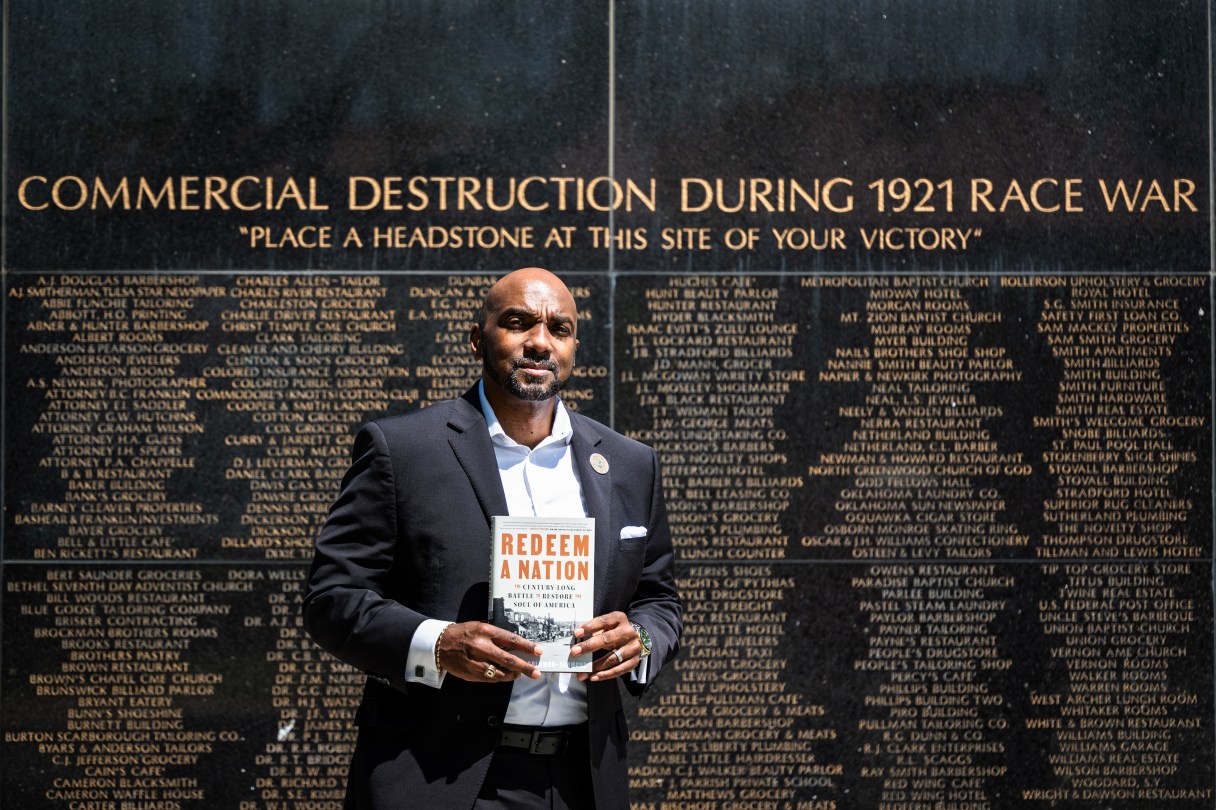
NEW YORK (AP) — It wasn’t until his junior year of college that civil rights attorney Damario Solomon-Simmons learned about a devastating massacre that took place in his hometown of Tulsa, Oklahoma.
His African American studies professor lectured about what is known today as the Tulsa Race Massacre — the days in 1921 when white mobs carried out a scorched-earth campaign against an outnumbered Black militia protecting the fabled Black Wall Street, a prosperous all-Black community.
“I actually told a teacher, ‘I’m from Tulsa. That’s not true,’” Solomon-Simmons recalled. “And of course, I was wrong.”
That day planted a seed for the then-aspiring attorney, who went on to lead a reparations campaign for the living survivors of the massacre and their descendants. Nearly 105 years later, no one has been compensated for what they lost, and none of the culprits have been held accountable.
That fight for reparations is the subject of Solomon-Simmons’ first book, “Redeem a Nation: The Century-Long Battle to Restore the Soul of America,” which is intended as a blueprint for justice in historic atrocities that Black Americans endured but never received reparations for. The book hits shelves Tuesday.