
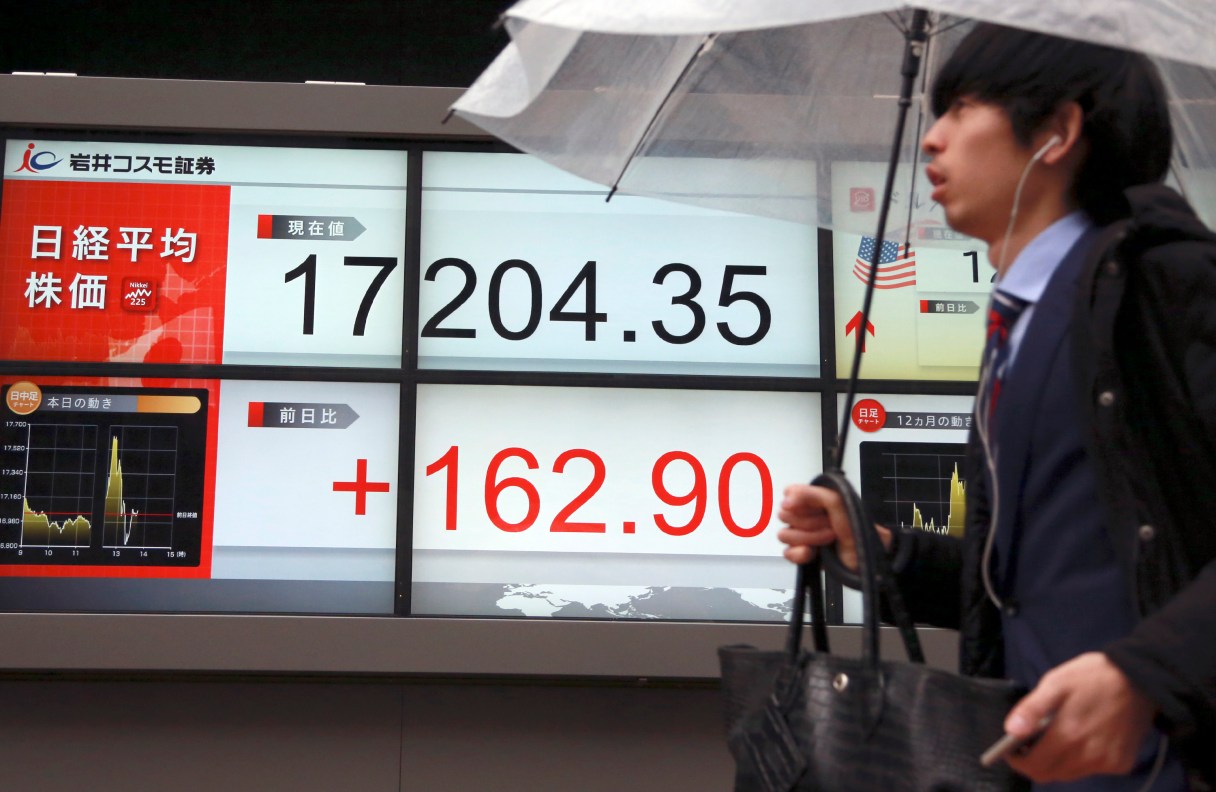
SEOUL, South Korea (AP) – Tokyo stocks finished nearly 3 percent higher on Friday while the yen dived after after the country’s central bank introduced a negative rate interest policy to boost the economy after previous stimulus efforts produced indifferent results. Other Asian markets were higher after China’s top economy official said there is no basis for the yuan to continuously weaken.
KEEPING SCORE: Japan’s Nikkei 225 reversed losses to finish up 2.8 percent at 17,518.30. The index swung between losses and gains, surging as much as 3 percent at one point after the BOJ announcement. The policy decision is a possible boost for the economy but viewed by investors as negative for banks. Shares of Mitsubishi UFJ Financial Group fell 3.8 percent. Hong Kong’s Hang Seng gained 1.8 percent to 19,551.14 and the Shanghai Composite in mainland China rose 2.6 percent to 2,723.69. Australia’s S&P/ASX 200 added 0.6 percent to 5,005.50 while South Korea’s Kospi erased earlier losses to finish up 0.3 percent at 1,912.06. Stocks rose in Taiwan, Singapore, Thailand and the Philippines but fell in Indonesia.
JAPAN RATE: The Bank of Japan said it is imposing a 0.1 percent fee on some deposits left with the central bank, effectively a negative interest rate. It hopes that will encourage commercial banks to lend more and stimulate investment and growth. Latest data showed Japan’s core inflation rate slipped 0.5 percent in 2015 on low oil prices while consumer spending fell 4.4 percent in December over a year earlier.
ANALYST’S TAKE: “Concerns had been mounting that the BOJ were increasingly tapped out in their ability to ease monetary policy,” Angus Nicholson, a market analyst at IG in Melbourne, Australia, said in a commentary. “The announcement opens the door to sustain further easing by the BOJ throughout the year.”
CHINESE YUAN: Chinese Premier Li Keqiang said on Thursday that there is no basis for continuous depreciation of the yuan, China’s official Xinhua news agency reported. In his phone conversation with International Monetary Fund Managing Director Christine Lagarde, Li said Beijing has no intention of boosting exports by devaluing the renminbi.