
Wednesday, November 11, 2026Nov 11

President Biden’s electric car plans hinge on having enough chargers

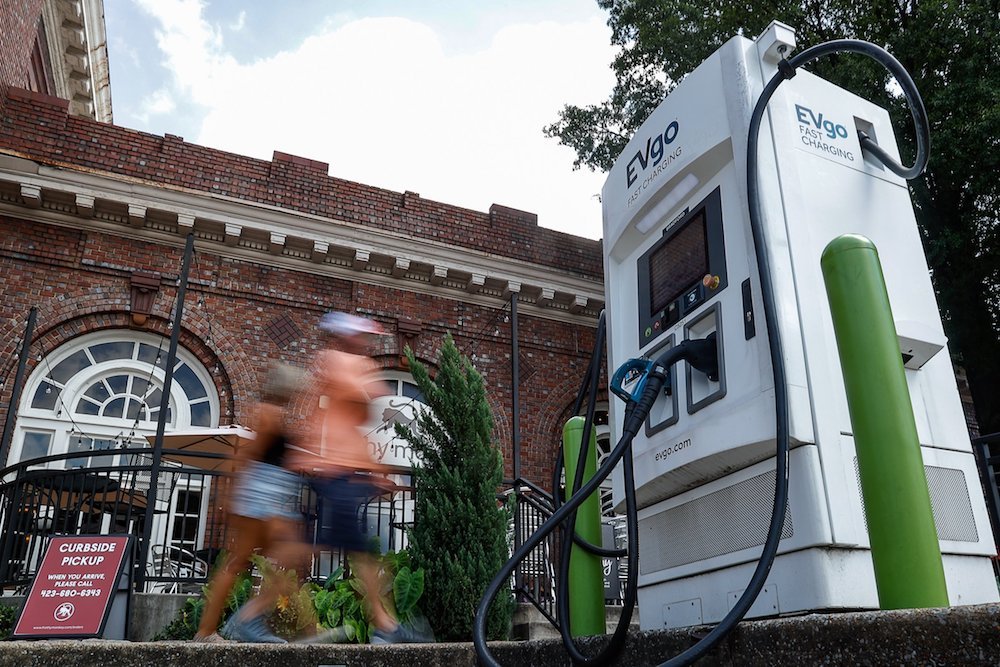
Staff photo by Troy Stolt / An "EVGO" electric vehicle charging station is seen outside of the Chattanooga Choo Choo on Tuesday, Sept. 7, 2021 in Chattanooga, Tenn. The state of Tennessee is planning to install fast-charging stations every 50 miles on major highways in the state under a $20 million program announced earlier this year by the Tennessee Valley Authority and the Tennessee Department of Environment and Conservation which will be funded by using part of the state's Volkswagen diesel emissions settlement money.
Staff photo by Troy Stolt / An "EVGO" electric vehicle charging station is seen outside of the Chattanooga Choo Choo on Tuesday, Sept. 7, 2021 in Chattanooga, Tenn. The state of Tennessee is planning to install fast-charging stations every 50 miles on major highways in the state under a $20 million program announced earlier this year by the Tennessee Valley Authority and the Tennessee Department of Environment and Conservation which will be funded by using part of the state's Volkswagen diesel emissions settlement money. Staff photo by Troy Stolt / An "EVGO" electric vehicle charging station is seen outside of the Chattanooga Choo Choo on Tuesday, Sept. 7, 2021 in Chattanooga, Tenn. The state of Tennessee is planning to install fast-charging stations every 50 miles on major highways in the state under a $20 million program announced earlier this year by the Tennessee Valley Authority and the Tennessee Department of Environment and Conservation which will be funded by using part of the state's Volkswagen diesel emissions settlement money.

In President Joe Biden’s vision of a green future, half of all new cars sold in 2030 will be electric. But something really basic is standing in the way of that plan: enough outlets to plug in all those cars and trucks.

The country has tens of thousands of public charging stations – the electric car equivalent of gas pumps – with about 110,000 chargers. But energy and auto experts say that number needs to be at least five to 10 times as big to achieve the president’s goal. Building that many will cost tens of billions of dollars, far more than the $7.5 billion lawmakers have set aside in the infrastructure bill.

Private investors are pouring hundreds of millions of dollars into building chargers, but the business suffers from a chicken-and-egg problem: Sales of electric cars are not growing fast enough to make charging profitable. It could be years before most charging companies break even, let alone mint big profits like Exxon Mobil and Chevron.

Fast chargers – ones that can fill up an electric car battery in 20-40 minutes – cost tens of thousands of dollars but are typically used less than humdrum gas pumps. Yet the auto and energy industries need to build them to reassure people they won’t be stranded in an electric car with no plug in sight.

“EV charging infrastructure is the single biggest barrier to EV adoption,” said Asad Hussain, a senior analyst at PitchBook, a research firm. “You talk to anyone who’s on the fence about buying an EV and the No. 1 concern that comes to mind is range anxiety.”