
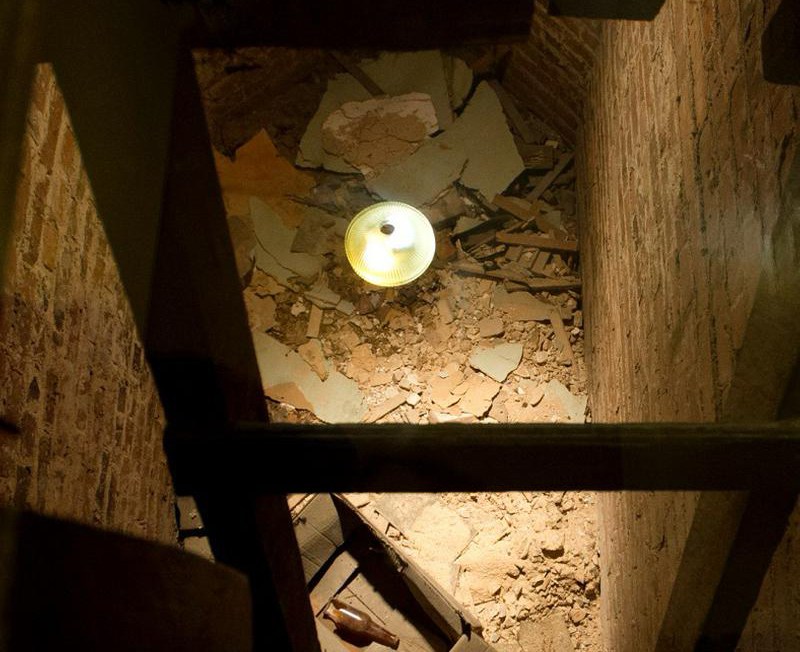
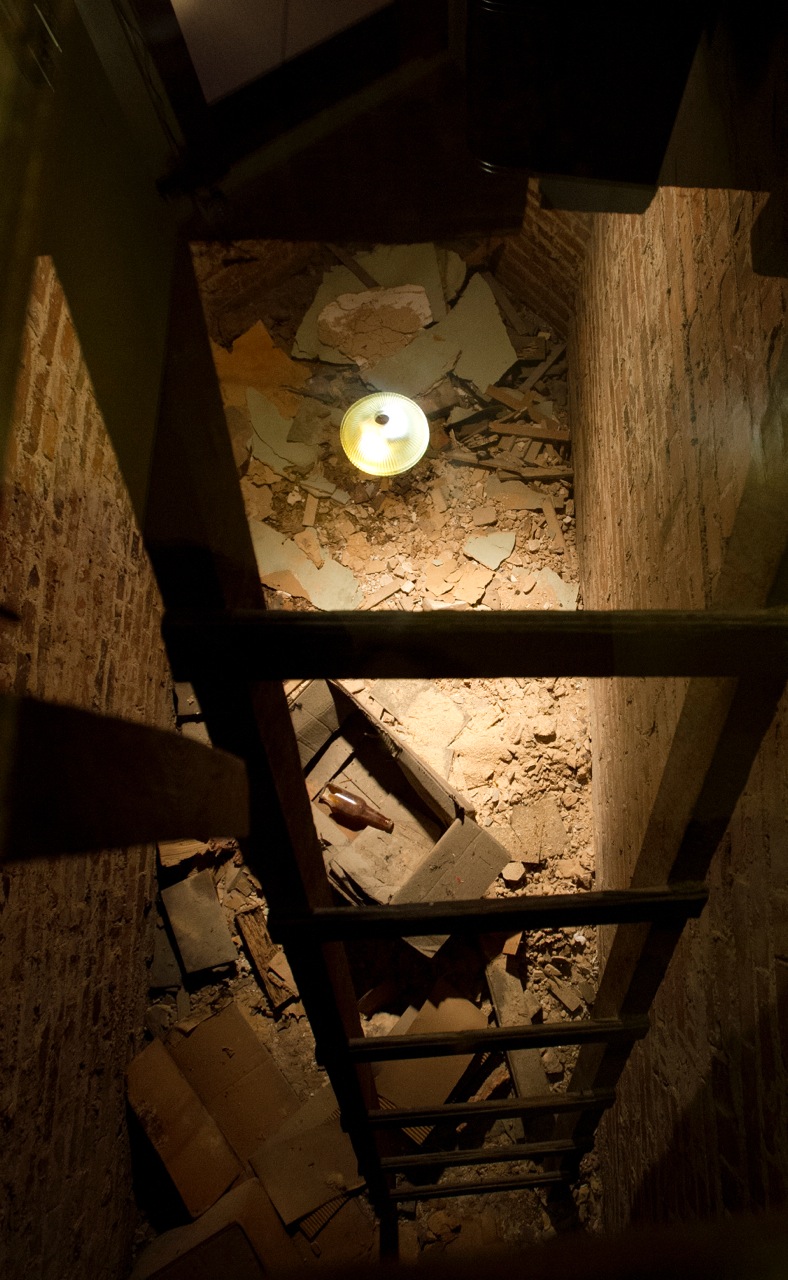
 A ladder leads to a Prohibition-era tunnel in Decatur, Ala.
Photo: Decatur (ALA.) Daily News
DECATUR, Ala. — David Armistead is accustomed to visitors coming into Tennessee Valley Pecan Co. to sample his pecans.
They still come for that, but now they also are coming to see a piece of Decatur’s history linked to the Prohibition era.
After moving his business from one location to another on Bank Street, Armistead learned from his landlord that the building has one of the city’s remaining tunnels used to keep booze out of sight.
These secret rooms and passageways — constructed primarily after the 18th Amendment to the U.S. Constitution banned the sale of alcohol — were used to hide liquor from federal enforcement agents, and in some cases, as an escape route for patrons.
This tunnel goes toward Bank Street, but there is no evidence that it ever went beyond the brick wall near the front part of the building.
A few empty bottles remain in the tunnel, but it mostly houses empty boxes with date stamps from the 1930s, when Prohibition ended.
“It’s like history frozen in time,” Armistead said.
Most of the boxes are so brittle they can’t be moved, so Armistead has placed a piece of Plexiglas over the tunnel entrance that allows visitors to see down the wooden ladder leading to the floor.
One of the boxes is for Cook’s Beer, an Evansville, Ind., company founded in 1853 by F.W. Cook and his stepfather, Jacob Rice.
“I’d like someone to explain how that got to Decatur,” Armistead said.
Morgan County archivist John Allison was already researching the city’s Prohibition era before learning about the tunnel. He found no evidence that anything other than “legitimate storefronts” existed in the building during Prohibition.
“I’ve heard about tunnels in Decatur, and we get people in here asking about them,” he said. “A lot of folks ask about tunnels leading to the Tennessee River, but I’ve never found anything showing these to exist.”
There are, however, plenty of records about Morgan County’s legal and illegal history with alcohol.
Before Prohibition began in 1920, state lawmakers passed the Smith Bill, a law that gave cities the option to license saloons.
After the 21st Amendment repealed Prohibition in 1933, Alabama kept laws in place that banned liquor sales until 1937. Allison said that may explain why one of the Cook’s Beer boxes in the tunnel has a 1936 date.
Armistead said he decided to make the tunnel visible to the public because about 80 percent of his customers are tourists.
“This building has a lot of charm, and we’re glad to be in it,” he said. “We made some renovations, but we kept this because it’s a neat part of the city’s history.”