
Wednesday, November 11, 2026Nov 11

Asian stocks uneven as oil falls, China concerns loom

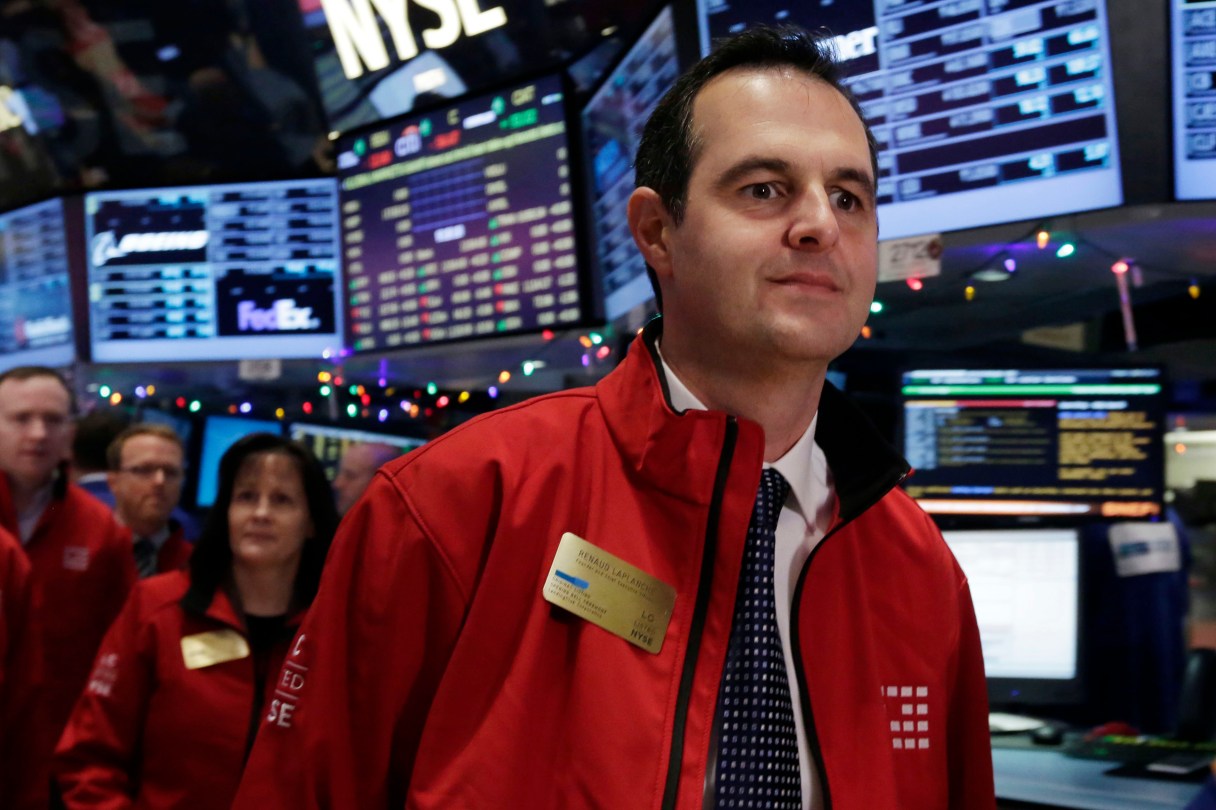
FILE - In this Dec. 11, 2014, file photo, Renaud Laplanche, founder & CEO of LendingClub, arrives on the floor of the New York Stock Exchange, prior to his company's IPO. The Treasury Department called for additional oversight and some increased regulations for the online lending industry on Tuesday, May 10, 2016, the first time a government agency has weighed in on this quickly growing, but largely unrelated, part of the financial world. It also comes at a time when LendingClub, the biggest online lending company, is under scrutiny from investors after the company altered a portfolio of sketchy loans in order to sell them to an investor. The scandal forced CEO Laplanche to resign and its stock to plunge more than 30 percent in two days. (AP Photo/Richard Drew, File)
FILE - In this Dec. 11, 2014, file photo, Renaud Laplanche, founder & CEO of LendingClub, arrives on the floor of the New York Stock Exchange, prior to his company's IPO. The Treasury Department called for additional oversight and some increased regulations for the online lending industry on Tuesday, May 10, 2016, the first time a government agency has weighed in on this quickly growing, but largely unrelated, part of the financial world. It also comes at a time when LendingClub, the biggest online lending company, is under scrutiny from investors after the company altered a portfolio of sketchy loans in order to sell them to an investor. The scandal forced CEO Laplanche to resign and its stock to plunge more than 30 percent in two days. (AP Photo/Richard Drew, File) FILE - In this Dec. 11, 2014, file photo, Renaud Laplanche, founder & CEO of LendingClub, arrives on the floor of the New York Stock Exchange, prior to his company's IPO. The Treasury Department called for additional oversight and some increased regulations for the online lending industry on Tuesday, May 10, 2016, the first time a government agency has weighed in on this quickly growing, but largely unrelated, part of the financial world. It also comes at a time when LendingClub, the biggest online lending company, is under scrutiny from investors after the company altered a portfolio of sketchy loans in order to sell them to an investor. The scandal forced CEO Laplanche to resign and its stock to plunge more than 30 percent in two days. (AP Photo/Richard Drew, File)

SEOUL, South Korea (AP) – Asian stock markets were uneven on Wednesday as the price of oil fell and concerns about China’s economy weighed on sentiment.

KEEPING SCORE: Japan’s Nikkei 225 edged up 0.1 percent to 16,579.01 while China’s Shanghai Composite Index added 0.5 percent to 2,844.80. But South Korea’s Kospi fell 0.1 percent to 1,980.10 and Hong Kong’s Hang Seng index lost 1.0 percent to 20,032.69. Australia’s S&P/ASX 200 gained 0.6 percent to 5,372.30. Shares rose in the Philippines but fell in Singapore, Taiwan and India.

ANALYST’S TAKE: “Things seem a little quiet in Asia-Pacific as markets take a breather from some recent volatility,” Stephen Innes, a senior trader at OANDA Asia Pacific, said in a commentary. “The danger of these calmer waters is always that sudden shock of a tidal wave from the Fed, China or another central bank tinkering with its monetary policies. For now, it looks like markets are heading for a mid-week nap.”

WALL STREET: U.S. stocks surged to their biggest gain in two months on Tuesday. The Dow Jones industrial average jumped 222.44 points, or 1.3 percent, to 17,928.35. The Standard & Poor’s 500 gained 25.70 points, or 1.3 percent, to 2,084.39. The Nasdaq composite index rose 59.67 points, or 1.3 percent, to 4,809.88.

OIL: Benchmark U.S. crude fell 40 cents to $44.26 per barrel on electronic trading on the New York Mercantile Exchange. The contract rose $1.22, or 2.8 percent, to $44.66 a barrel on Tuesday. Brent crude, the benchmark for international oil prices, fell 41 cents to $45.11 a barrel in London.