
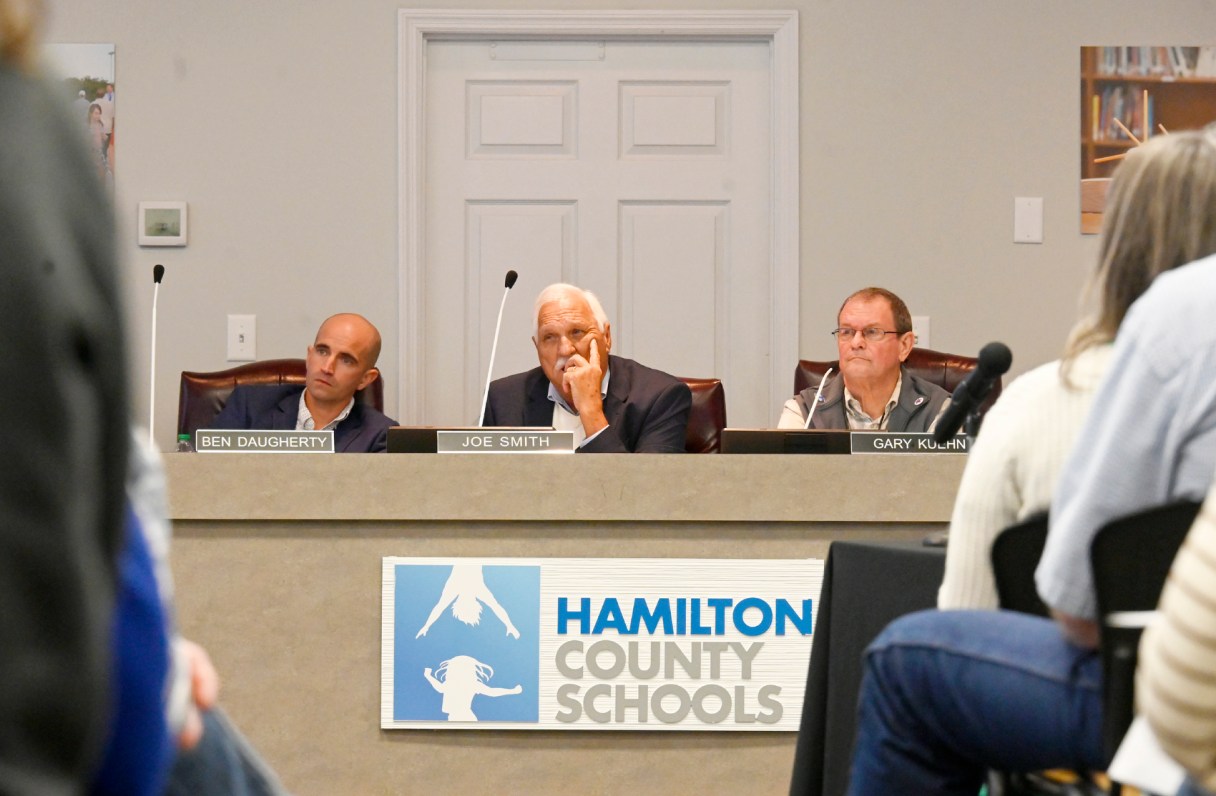
The Hamilton County school board will vote next week on its 2026 legislative agenda, which includes recommendations for Tennessee lawmakers related to public education funding and state testing.
The legislative agenda, which is separated into seven areas, serves as the message board members use when talking with lawmakers.
The school system also hopes the agenda can be used to help drive legislation by leading to lawmakers introducing or adding to existing bills, said Rachel Emond, the district’s strategic project and policy administrator.
Here’s a breakdown of what — if approved at the board’s Dec. 18 meeting — board members plan to advocate for in the coming year.
STATE FUNDING
At the top of the draft legislative agenda presented to school board members Monday was guidance and feedback for Tennessee lawmakers on how they could improve the state’s public school funding formula, Emond said. In 2026, a review committee is set to evaluate the formula’s funding allocations, as well as identify any needed changes.
The board’s legislative agenda advocates for lawmakers to include in the funding formula provisions for school infrastructure, increased funds for certain students with disabilities and support for areas mandated by the state — like special education pre-kindergarten and summer learning programs — where districts receive less funding than the cost of implementation.
(READ MORE: 2026 will be a pivotal year for public education in Tennessee, advocates say)
It also asks lawmakers to change the way Tennessee classifies economically disadvantaged students — one of the characteristics that gives schools extra funding under the formula. The state defines economically disadvantaged as students who are directly certified because their families receive certain forms of government assistance, as well as homeless, foster, unaccompanied and migrant students.
“We’re seeing a significantly smaller number of students being coded as economically disadvantaged even though we have a higher number of students with verified economic need through free and reduced lunch,” Emond said.
The draft agenda doesn’t take a stance on the existence of the Education Freedom Scholarship program, which gives 20,000 Tennessee students state funding for private school tuition. In past years, the board’s legislative agenda has urged lawmakers not to expand the state’s tuition grant programs in any way or supported keeping certain guardrails in place.
This year’s agenda asks the legislature to ensure that if it increases the amount of funding for tuition subsidies for private school students, that public education funding increases at the same rate. Gov. Bill Lee and some other Republican lawmakers have called for the program to be expanded next year to meet demand.
TESTING
The legislative agenda advocates for reducing the amount of state testing requirements, particularly for screeners in kindergarten through eighth grade and end-of-course exams in high school.
The state requires elementary students to be screened in math and English three times a year, while middle school students are tested twice, according to a district information sheet from March. High school students take seven subject tests over the course of four years.
(READ MORE: Hamilton County school board members question educator diversity policy)
“If we really want to reduce the amount of testing, we’ve got to have some flexibility with the state on looking at that,” Superintendent Justin Robertson said. “We’re not saying, certainly, don’t take all testing away, but be able to look at it more constructively per kid and where we should need it and where we don’t need it.”
Reducing testing has been a focus of school board members this past year, and in May, as part of approving the district budget, the board voted to reduce benchmark testing from three times a year to once.
FEDERAL FUNDING
Lee and the state’s education commissioner have both expressed interest in Tennessee receiving its federal education funding through a block grant.
The legislative agenda advocates for ensuring any efforts taken by Tennessee officials to reduce federal accountability don’t jeopardize the total amount of funding received by the state. About $1.3 billion of Tennessee’s public education expenditures came from the federal government during the 2023-24 academic year, according to a July presentation by the State Comptroller’s Office.
It also asks lawmakers to require the Tennessee Department of Education to distribute federal block grants in a method that’s aligned with the state’s public school funding formula.
That means dispersing the funding based on student enrollment and need instead of sending every county the same amount of money, Robertson said. Following the guidelines the legislature set with the funding formula would prevent smaller, rural areas from getting an oversized benefit from the shift.
“There’s many more smaller counties that get to vote on it than larger counties,” said Vice Chair Gary Kuehn, R-Ooltewah. “The smaller counties get the same piece of the pie, but they have 10 times less students with that piece of pie.”
Other points on the legislative agenda include asking lawmakers to change the requirements for out-of-state teachers to become licensed in Tennessee, as well as allow districts to get reimbursed for hiring school security officers in cases in which local law enforcement agencies are unable to provide a school resource deputy.
School resource deputies are employed by a local law enforcement agency, while school security officers are employed by a school district and serve in a similar capacity but are not legally authorized to make arrests. Hamilton County Schools uses a combination of both to ensure there is an armed officer in every building.
Contact education reporter Shannon Coan at scoan@timesfreepress.com or 423-757-6396.