
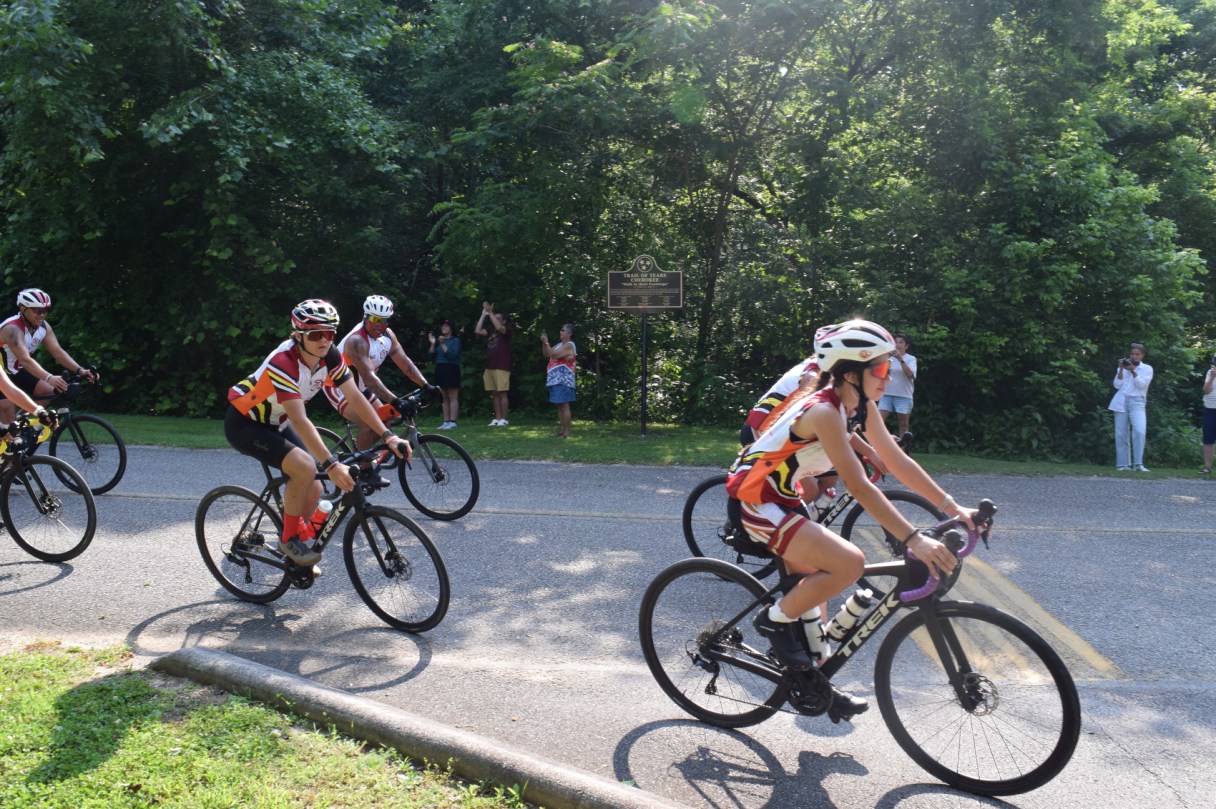

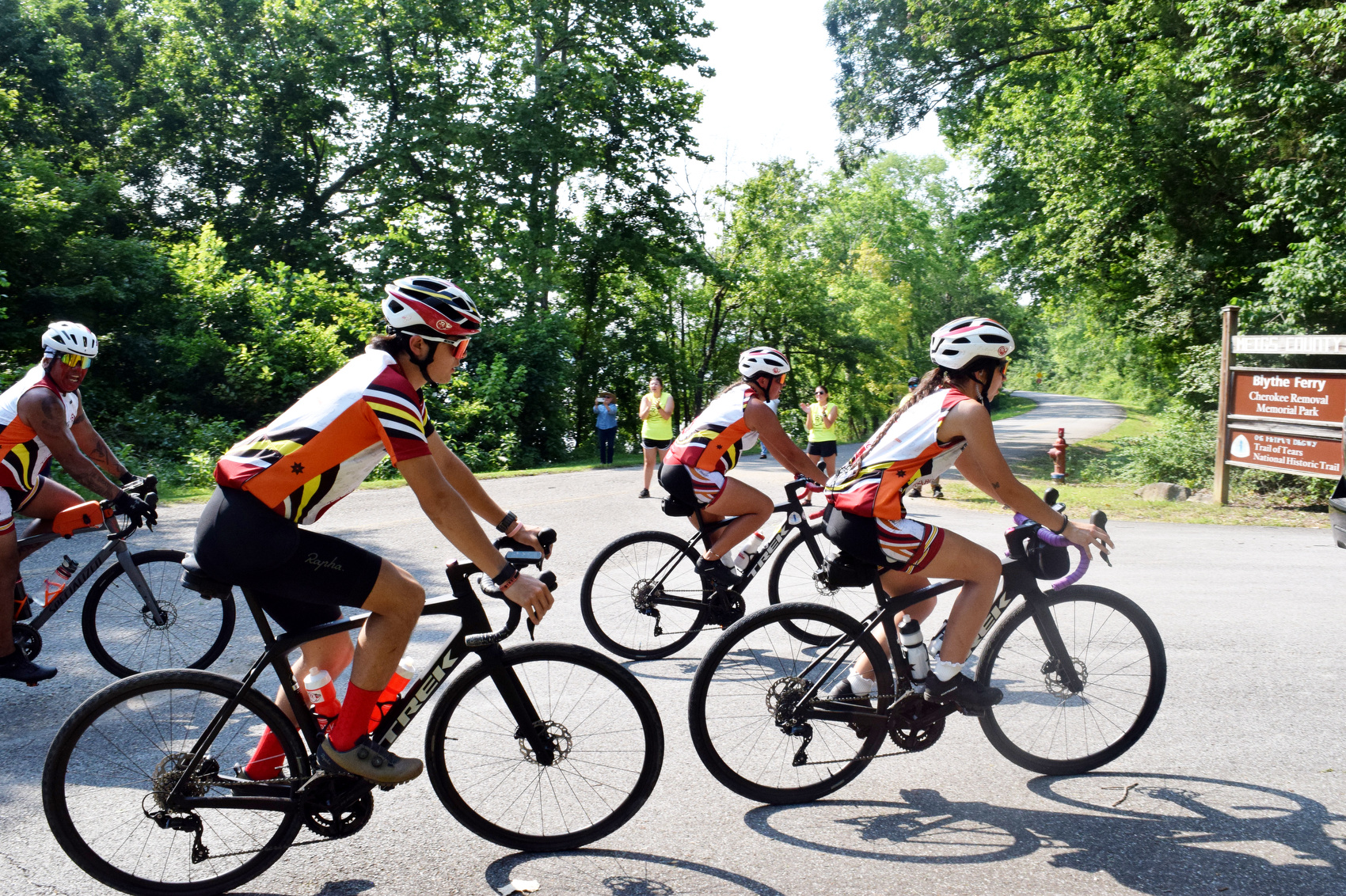
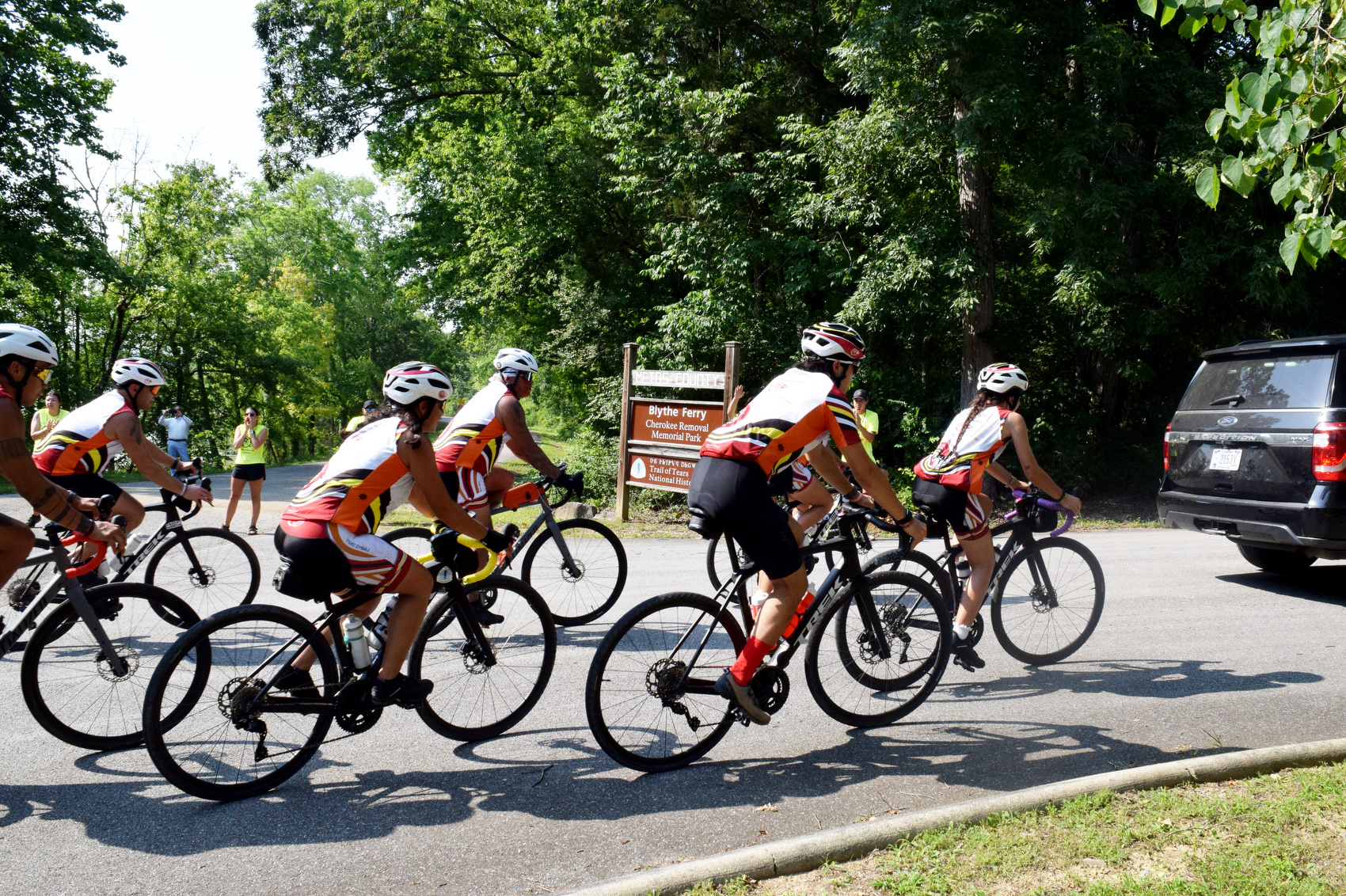
BIRCHWOOD, Tenn. — After two days’ sweating under an early-June sun, traveling from New Echota in Georgia, 18 Cherokee Indian cyclists arrived at Blythe Ferry on the eastern shore of the Tennessee River, about 30 miles north of Chattanooga in Meigs County.
In 1838 and 1839, nine of 13 detachments of Cherokee men, women and children were gathered there to be ferried across the river on the forced march west. From there, they looked back upon their homeland for the last time before being forced west on what would become known as the Trail of Tears.
The riders — 12 from the Cherokee Nation in Oklahoma and six from the Eastern Band of Cherokee Indians in North Carolina — are tracing a 950-mile route used by the Cherokee when federal authorities acted under the Indian Removal Act of 1830. The act directed federal negotiations for Indian lands, forcing the removal of Native American tribes from their homelands. Besides the Cherokee, the Chickasaw, Choctaw, Creek and Seminole tribes were also to be relocated west of the Mississippi River.
Cherokee riders visit ‘point of no return’ at Blythe Ferry
TRAIL OF TEARS
The majority of Cherokee people refused to voluntarily abandon their ancestral homelands despite the 1835 Treaty of New Echota specifically signed by a minority of Cherokee leaders that included Major Ridge, John Ridge, Elias Boudinot and Stand Watie. The treaty was later protested by John Ross, the principal chief of the Cherokee from 1826 to 1866 and for whom Chattanooga’s Ross’s Landing is named, according to Cherokee Nation historical accounts.
In 1838, the federal government deployed troops under Gen. Winfield Scott to forcibly round up the Cherokee people into relocation camps and, from there, remove them overland to the reservation west of the Mississippi. The Cherokee Nation was reestablished in what would become its new capital in Tahlequah, Oklahoma.
(READ MORE: Moccasin Bend study turns up more than 3,700 artifacts)
Of the estimated 16,000 Cherokee forced to march to Indian territory, about 4,000 died of exposure, starvation and disease, earning the path of the tragic march the name the Trail of Tears.
The Remember the Removal bike ride aims to draw attention to the significance of the tribe’s forced relocation as the riders ride and walk portions of the Trail of Tears, Cherokee Nation spokesperson Ray Walsh said at the Cherokee Removal Memorial Park at the Tennessee River in Meigs County. The ride marks the 17th edition of the trip in more than four decades.
Blythe Ferry is central to telling the history of the Cherokee removal, Walsh said.
“The Remember the Removal program started in 1984,” Walsh said. “That was the year of the inaugural ride. Will Chavez — he’s here as a staff member — he goes every year, but he participated in the original 1984 ride.”
1984 RIDE
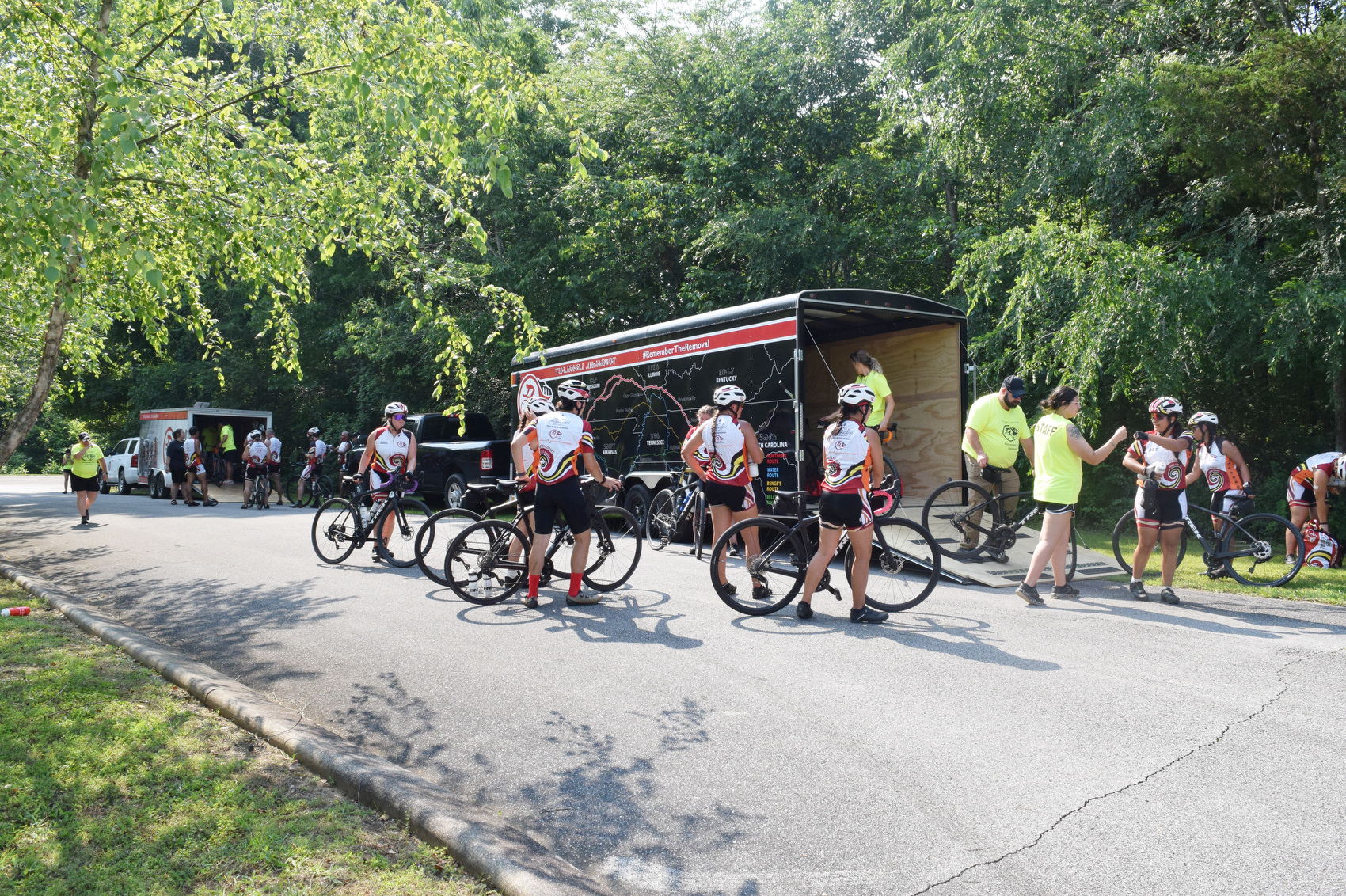
Chavez was 17 when he became part of the first bike ride along the Trail of Tears, he said, sitting in a rocking chair on the porch at the park visitor center as he watched the young riders tracing names of ancestors. The ride was less formal then, Chavez said, and the support team didn’t have the team trucks and trailers, the latest technology and replacement parts ready for any rider with a mechanical problem along the way. A support team for the group developed as the ride stretched over the years.
The idea for the ride came from Mike Norris, who sparked youth leadership programs elsewhere in 1980s and thought it would be good for the Cherokee Nation, Chavez said.
“I was a 15-year-old kid when Mike was organizing this in 1983, and then in ’84, we stood off. I was 17, and there were 20 riders, mostly teenagers,” Chavez said. “But we left from Cherokee, North Carolina, instead of how we do it now, leaving from Georgia.”
That year, the riders covered roughly 1,200 miles, he said.
Chavez said the young riders are getting as valuable an experience as he did.
“I got more confidence after that, you know, thinking I could do just about anything,” he said. “I think a lot of my teammates felt the same way.”
Chavez has observed a similar phenomenon in the young riders.
“It’s like they’re almost required to dig so deep to do this,” he said. “They can see more of what they’re capable of.”
REMOVAL RIDERS
Rider Adriauna Garcia, 19, of Tahlequah, is taking her first Remember the Removal journey.
“I wanted to do the ride to honor my ancestors and reiterate what they did and really strengthen my Cherokee roots to pass them on to generations ahead of me,” Garcia said. “That’s something really important to me. That’s something I really want to keep with me forever.”
Garcia’s family speaks fluent Cherokee and values the tribe’s cultural roots, she said.
Alongside Garcia, rider Kacey Fishinghawk, 23, of Tahlequah, said she was raised outside of the modern Cherokee cultural experience, so she wants to learn as much as she can from the ride.
“I chose to do the ride mainly just to be more connected with my Cherokee roots,” Fishinghawk said, fresh off her bike. “Unlike Adriauna, I grew up in a nontraditional Cherokee family. So, it was kind of like, yeah, there were stories here and there, but I wanted to be more connected with that side of my life. And I wanted to raise awareness.”
The ride leading up to Blythe Ferry was otherworldly, she said.
“It’s kind of surreal,” Fishinghawk said, “like you feel like you’ve been here before, even though some of us never have.”
Garcia agreed.
“Whenever I saw the mountains when we were leaving North Carolina, you know, it just feels like home,” Garcia said, recalling the mountains’ famous blue haze. “Whenever you see them, and you see the smoke, and you feel like — it’s hard to explain — but just like a weight on you. And coming state to state, you know, stopping at those historical sites — they’re not historical sites, they are home, and you really do feel that.”
Rider Kalina Campos, 25, of Concord, California, was a long way from home and had a tough time just participating in the ride.
“It’s been quite a journey to get here,” Campos said as she cooled off inside the park visitors center. “I’m just really truly blessed to have been able to have this opportunity that not many get.”
Campos had less than a month from the time she was notified she could participate until she had to be ready to begin training in Oklahoma, she said.
“So I had about 3 1/2 weeks, give or take, to kind of figure out my life and figure out work, how am I going to get out there, all of that, so it was a pretty hectic time,” she said. “It’s one of those things where if it’s meant to be, it’ll happen.”
Campos, a nurse, always wanted to learn more about her Cherokee roots, she said, but gaining that knowledge while living so far from the Cherokee Nation was a challenge.
“It’s hard to feel connected to the culture when you’re so far away,” she said.
Campos wanted to return to the Cherokee Nation in Tahlequah as a nurse, but the bike ride led her there quicker.
“I just never thought that I would get to Tahlequah because of a bike ride instead of nursing,” she said. “But it’s been the best experience I could have ever asked for. I have learned so much. I have gained so much knowledge. I’m sharing all of that knowledge with my family back home, and they’re absolutely loving it. “
Heather Fite, 47, Cherokee Nation youth leadership manager in Tahlequah, was part of the 2024 ride and is joining in this year’s ride as something of a veteran. Fite said she rode with her daughter in 2024 and is riding alongside her son this year.
“We are tracing the steps of our ancestors on the northern route and patrol teams,” Fite said. “It’s going to take approximately three weeks for us to complete the ride, and on average, we’re doing about 60 miles a day.”
Fite’s sister participated in the ride in 2010, she said, and after years of consideration, Fite and her daughter, Bailey, joined the ride for the first time a year ago. The side-by-side ride acted to link the mother with her children, their heritage and their history at the same time.
As Fite rode this year with her son, Cameron, at her side, he queued up Bailey’s favorite Miley Cyrus song, “The Climb,” as Fite reflected on what it meant to be a family on the Trail of Tears.
“It just kind of hit me like, here I am with Cameron, and we’re going up this mountain together, and you know our ancestors did the same exact thing,” Fite said. “And I’m going home to my daughter, but they were going ‘home’ to nothing. You know, they didn’t know what they were going to end up in, what their lives were going to be, and they were leaving behind family members. So, in my head, I’m thinking about, I’m here with Cameron, but I’m missing Bailey, and I just started crying. It hit me like that.
“And I look over and Cameron’s crying, too,” she said, reliving the moment. “We didn’t ever really speak about it, but we both felt the same thing. And that was such a powerful day for us both. We’re stronger together. And that’s how our ancestors were. They were stronger because they experienced it together.”
‘SAY GOODBYE’
In the shadow of the tragedies Cherokee families faced on the Trail of Tears, Blythe Ferry in Meigs County is one of the most emotional stops for many.
“It is highly significant,” Fite said. “As we go down to the ferry when we cross the river there, that’s the last time that our ancestors could see our homeland. Once they look back at those mountains, they just disappear into the past.”
The riders experience something similar, she said.
“It’s almost like we train for this bike ride, go through history lessons and language lessons and everything, and you know it’s coming,” Fite said. “But not until you get to the ride and start that first day does it actually become real. Now you’re like, ‘Oh, yeah, I’m really doing this.’ I feel like that’s probably how our ancestors felt, too. They’re actually at the edge of their land, and now they’re having to leave. So, it is reality. They’re losing family members, their homes.”
As the sun descended toward the horizon across the Tennessee River from Blythe Ferry Landing, the young riders seemed burdened by the upcoming boat ride and what it represented.
(READ MORE: Cherokee Nation donates more than $100,000 to Trail of Tears associations)
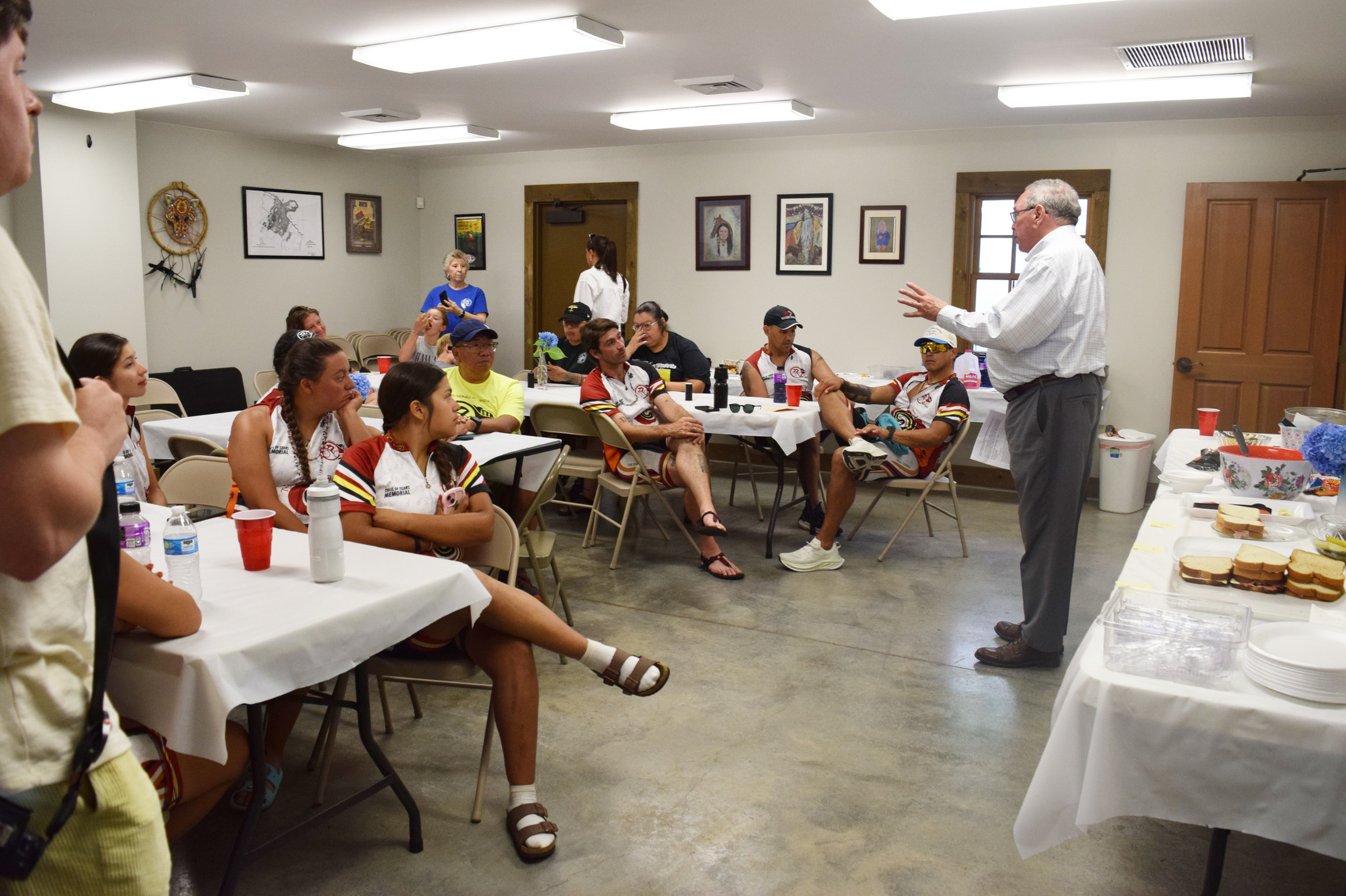
In a short meeting with the riders before they journeyed across the water, Jack Baker, Cherokee historian, president of the Trail of Tears Association and former longtime member of the Cherokee Nation Tribal Council, urged them to focus on the meaning of the crossing.
“That’s something I really want to emphasize to you, is that when you cross the Tennessee River, you’re leaving the old Cherokee Nation,” Baker said with a trembling voice. “The Cherokee people all knew this. They knew that as they were crossing, looking back, they were leaving their homeland forever. So, just think of that.
“Say goodbye.”
For Fishinghawk, the coming departure over the water toward the Cumberland segment of the ride resonated with personal pain and the anguish of her ancestors.
“We’re saying goodbye to this part of our lives, really, like even though we’ve never been here, this is our home,” she said, her composure beginning to dissolve. “And we have to say goodbye just like our ancestors did, and that was their point of no return. Very emotional.”
The riders Thursday were crossing Missouri on the 10th day of their ride, according to social media updates from the cycling team. Fishinghawk led the way for the day.
Friday, the riders continued making their way toward Oklahoma. They expect to reach their destination, the end of the Trail of Tears in Tahlequah, by June 20.
Contact Ben Benton at bbenton@timesfreepress.com or 423-757-6569.
Note: This story was updated on June 14 to remove a mistaken reference to the Cherokee’s last capital in the east.