
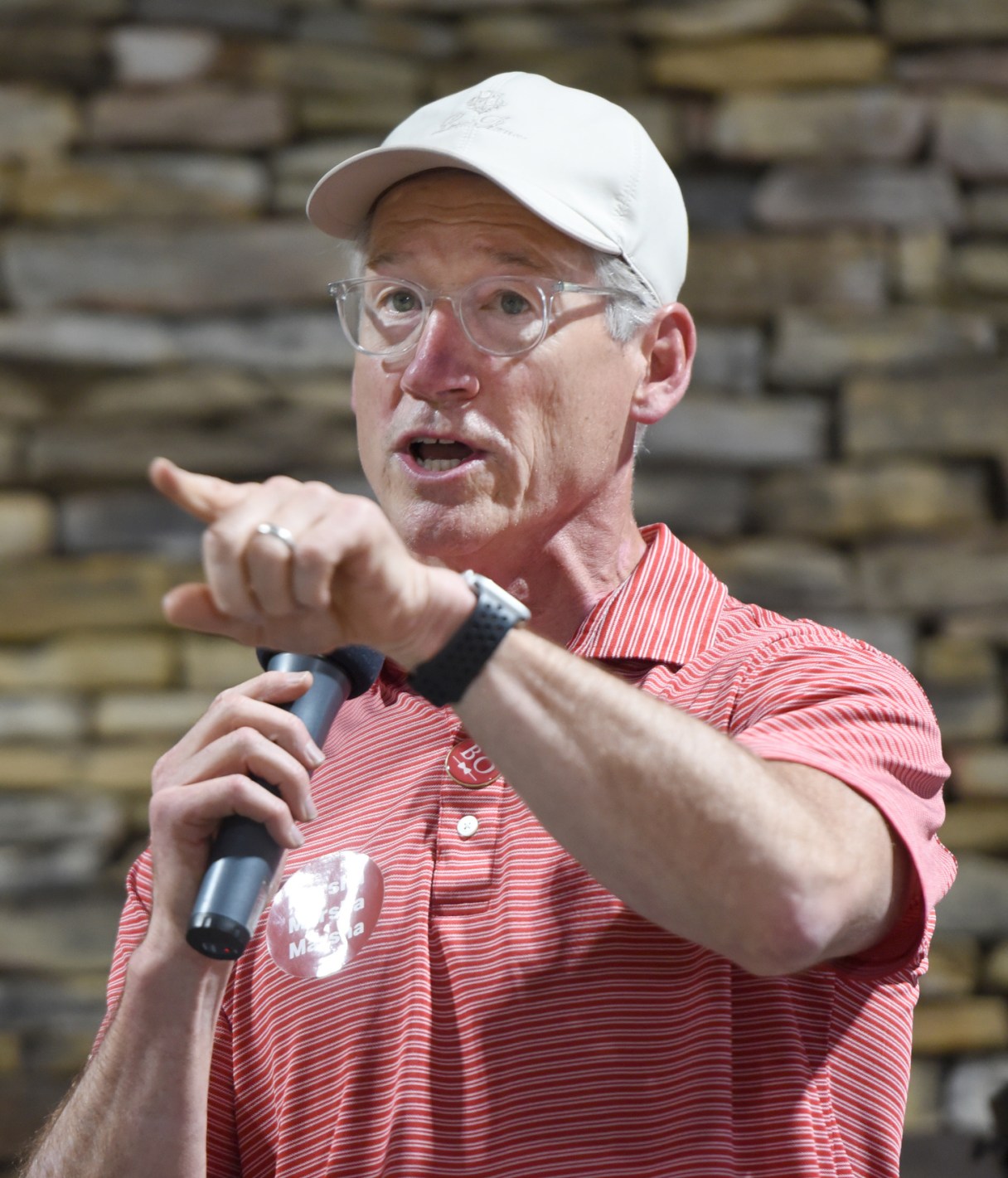
COLLEGEDALE — Tennessee state Sen. Bo Watson, R-North Chattanooga, announced he will seek reelection in 2026 on Sunday in front of hundreds at Bo’s Bash, an event hosted by the senator for the fourth year in a row.
It would be his fifth term in the Senate if reelected. Before being elected to the Senate in 2006, Watson was first elected to the House in 2004.
“I’m excited today to announce to you that I’ll be seeking re-election in 2026,” Watson told the crowd of about 400 people.
U.S. Sen. Marsha Blackburn, R-Tenn., a candidate for Tennessee governor, introduced Watson from the stage before his reelection announcement. Watson has endorsed Blackburn for governor.
U.S. Rep. Tim Burchett, R-Knoxville, U.S. Rep. Chuck Fleischmann, R-Ooltewah, and Gail Greene, chair of the Hamilton County Republican Party, also spoke to attendees before Watson took the stage.
Watson characterizes himself as one of the more conservative members of the General Assembly. Until 2006, the Republican Party had been in the minority in the General Assembly since 1869.
STATE BUDGET
“Tennessee is a very conservative state. So that’s good for a conservative member like me,” Watson said in an interview with the Chattanooga Times Free Press. “Obviously my principal responsibility as a sitting member and as a candidate is to make sure that the state’s economy is healthy, because that means the state’s revenues are healthy and the state can function and keep taxes low.”
Since 2011, there have been $8 billion in total tax reductions to the state, Watson said. He serves as chairman of the Senate Finance Committee and said he wants to keep taxes low. Tennessee does not have a state income tax.
Tennessee’s federal funding for food assistance will be reduced as a result of the passage of what Republicans called the “one big beautiful bill.” Watson said the state is not obligated to replace federal funding for the Supplemental Nutrition Assistance Program.
“We’ll have to have a discussion about, you know, some of those programs. Do we fund them, or do we not fund them?” Watson said. “But no state is in a position to assume the benefits of SNAP. Nobody’s in that position without completely depleting their resources. Those aren’t programs that we created. That’s a federal responsibility.”
The General Assembly will need to decide whether to use state dollars to fund some of the summer school and school tutoring programs that have been funded by expired federal dollars in the upcoming budget process.
Watson said he does not know right now which of these programs he would support for the use of state funding to continue, waiting for the governor’s budget to be released.
“I’ve been on finance, and my primary responsibility has been the economy and jobs, because if you build that foundation, everything else can be supported. If you don’t have that foundation, nothing else can be supported,” Watson said. “So all the things that we might want to fund, might want to do, if we’re not taking care of that basic fiscal responsibility, then we just can’t do it.”
Aside from working on the finance committee, Watson said he is most proud of his de-annexation bill that allows disgruntled voters in sections of cities annexed by ordinance after 1999 to secede, a bill that ended the emissions testing requirement for vehicles, and his help creating a new state formula for determining school funding that became effective in the 2023-24 school year.
Outside of continuing to work to keep state taxes and budget low, Watson said he hopes to continue to improve the state’s infrastructure and “tamp down on illegal immigration.”
IMMIGRATION
This year, Watson introduced a bill that would allow Tennessee schools to deny unauthorized immigrant students a public education.
The legislation, Senate Bill 836, passed the state Senate 19-13 on April 10 and now and now sits in a House subcommittee.
Watson’s bill would require public schools to verify students’ citizenship or immigration status during enrollment. It would also give school districts the opportunity to charge unauthorized immigrant students tuition and potentially deny them enrollment.
(READ MORE: Watson plans to see immigration bill to the finish line)
Blackburn applauded Watson as a leader on immigration in the speech she gave at the event.
“We’ll see how that works its way through the process, and then how that works with the court challenge that is there,” Blackburn said in an interview. “What we do know is Tennesseans want to make certain that if you have children that are in the country illegally, that they are paying the tuition, taxpayers are paying taxes, and people want to make certain, and you hear that all over the state.”
The U.S. Supreme Court in 1982 found it was unconstitutional to deny a public education to students based on their immigration status, but the lawmakers behind the Tennessee legislation are hopeful today’s Supreme Court will overturn the precedent.
The legislation has seen significant opposition from pastors across the state, from businesses in Watson’s district, from the Hamilton County school board, and from people passing out flyers at Watson’s own church. The new activist leaders of the Hamilton County Republican Party support the bill.
TUITION SUBSIDIES
Watson defines school choice as broader than the legislation passed at the beginning of the year that gives thousands of families across the state taxpayer funding to put toward private school tuition.
(READ MORE: Watson says Republicans improved state education)
Hamilton County legislators were split on the scholarship program. The chair of the Hamilton County Republican Party criticized the program rollout for a lack of transparency and its use for Islamic schools.
Watson said the roll-out went “fairly smoothly” and “you cannot dispute the success of the program.” Watson said he supports expanding the program so long as it can be done in a fiscally responsible way.
No other candidates have announced they are running against Watson. Watson did not have a Republican primary competitor in the 2018 or 2022 elections. In 2022, he went unchallenged in the primary, and in the 2018 general election, Watson beat Democratic challenger Randell Price with 65.1% of the vote.
Watson said the best part of the job is being able to interact with people in the community he was raised in and has spent most of his life in.
“To represent the people that, in the end, the community that I’ve spent virtually my entire life in, it’s an amazing, amazing, responsibility. It’s very humbling, but it’s also really, really exciting,” Watson said. “And because I move around in all these places, I’m constantly interacting with the people that I live and work with. And that’s just cool, right?”
The 2026 general election is on Nov. 3, 2026.
Contact politics reporter Ruby Rayner at rrayner@timesfreepress.com or 423-757-6556.