
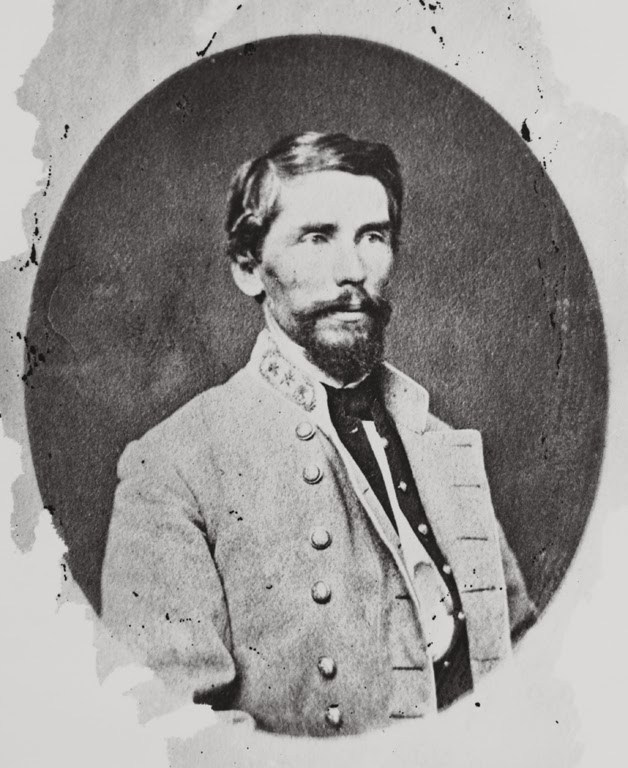
Editor’s note: sixth in a series on Civil War notables.
Patrick Ronayne Cleburne was an Irish-born Confederate major general, widely regarded as one of the most able combat commanders of the Army of Tennessee and often called the “Stonewall of the West.” He had a remarkable war record, demonstrating sterling prowess in Chattanooga battles and making a controversial proposal to free and then enlist enslaved people.
Cleburne was born in March 1828 in County Cork, Ireland, into a middle-class Protestant family. After failing to gain admission to study medicine at Trinity College, Dublin, he enlisted in the 41st Regiment of Foot (infantry) of the British Army in 1846 and served three years before purchasing his discharge.
(READ MORE: Local History: Arthur MacArthur and the Battle of Missionary Ridge)
He emigrated to the U.S. in 1849, settling in Helena, Arkansas, where he became a partner in a drugstore. Afterwards, he practiced law, also taking part in local politics, serving as a delegate to the 1858 Democratic Convention.
At the outbreak of the Civil War, he enlisted with the Confederate Army and quickly rose to a division commander in the local militia.
Cleburne’s unit soon gained notice for discipline and battlefield performance. Promoted to brigadier general in March 1862, Cleburne led a brigade at Shiloh, Richmond, Perryville — where he was twice wounded — and Stones River, earning promotion to major general in December 1862.
As a division commander in the Army of Tennessee, Cleburne distinguished himself at Chickamauga, where his attacks helped pressure Union Gen. George Thomas’s lines. At Missionary Ridge, his soldiers resisted a much larger force under Maj. Gen. William Sherman on the north end. At the Battle of Ringgold Gap, Cleburne’s men again protected the Army of Tennessee as it retreated to Tunnel Hill, Georgia. The Confederate Congress formally thanked him and his men for covering the army’s retreat.
(READ MORE: Local History: Survivors of ‘The General’ raid return to Chattanooga after Civil War)
Cleburne’s hard-fighting reputation, coolness under fire and repeated success in defensive and delaying actions earned him the sobriquet “Stonewall of the West,” likening him to Thomas J. “Stonewall” Jackson in the Eastern Theater. Contemporaries — including some Union officers — regarded his division as one of the best, if not the best, in the Army of Tennessee.
By late 1863 and early 1864, Cleburne concluded that Confederate manpower shortages and the Union’s growing strength made defeat likely unless drastic measures were taken. In January 1864, he presented a proposal to Army of Tennessee leaders advocating emancipation of enslaved people and their enlistment as Confederate soldiers, calling slavery the South’s “most vulnerable point” and “a continued embarrassment.”
The emancipation/enlistment proposal met a cold reception and harmed his prospects for higher command, as senior leaders feared political and public backlash. Historians note that Cleburne himself never owned slaves and that his plan was driven more by military pragmatism than abolitionist ideology, though it implicitly challenged core Confederate assumptions.
During the 1864 Atlanta campaign, Cleburne’s division fought in a series of engagements — including Dalton, Resaca, Pickett’s Mill, Kennesaw and others — often serving as a shock force or rear guard. At Pickett’s Mill in May 1864, his troops repulsed a determined Union attack, winning considerable praise for their tenacity and tactical handling.
After Atlanta, Cleburne marched north with Gen. John Bell Hood and took part in maneuvers around Spring Hill, Tennessee, on Nov. 29, where Confederate failures allowed the Union army to escape toward Franklin. Cleburne, frustrated and concerned about being blamed for the missed opportunity, intended after the campaign to demand a formal inquiry into Spring Hill events.
(READ MORE: Local History: Kate Cumming, Confederate nurse, recorded her experience)
On Nov. 30 at the Battle of Franklin, the impulsive Hood ordered frontal assaults against fortified Union positions south of Nashville, an attack Cleburne opposed but carried out.
Cleburne had his horse shot out from under him during the advance, continued on foot, sword in hand, urging his men forward until he was struck by a bullet and killed at close range near the Union earthworks.
His body, stripped by scavengers of valuables including sword, boots and pocket watch, was recovered by Confederates and initially buried near St. John’s Church in Maury County, Tennessee, a spot he had admired for its resemblance to his Irish homeland. In 1870 his remains were reinterred with ceremony in Maple Hill Cemetery in Helena overlooking the Mississippi River, reinforcing his symbolic status as an Arkansan adopted son.
Shortly before the 1864 Tennessee campaign and after meeting at a wedding, Cleburne became engaged to Susan Tarlton of Mobile, the daughter of a slave-owning cotton farmer, but the couple never married due to his death at Franklin.
His friend and patron, Gen. William Hardee, wrote that Cleburne was “an Irishman by birth, a Southerner by adoption and residence, a lawyer by profession, a soldier in the British army, and a soldier in the Southern armies from patriotism and conviction of duty in his manhood.”
Gen. George Gordon said in his memorial address: “A truer patriot or knightlier soldier never fought and never died.”
Frank “Mickey” Robbins, National Park Partners board member, coordinates the local history column. For more information, visit Chattahistorialassoc.org.