
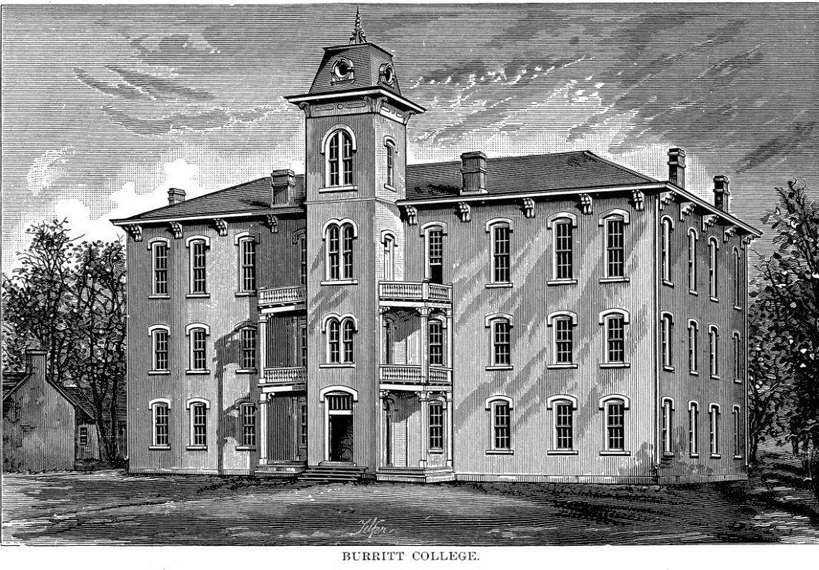
In 1848 the Church of Christ established a high school and college on the Cumberland Plateau above Spencer, Tenn. The school was named after Elihu Burritt of Worcester, Massachusetts, who was active in the peace movement opposing the Mexican War of 1848 and helped cause the Church of Christ to leave the Presbyterian Church.
The motto of Burritt College was “Scholarship, Dignity, Worth of Labor, and Service to Man.” One of its early brochures described an institution with a “beautiful campus, Christian influence, splendid gymnasium and electric lights.”
William Davis Carnes, president of the college in 1850, instituted co-education and a strict moral and religious code, stating “It is God’s law that the young of the opposite sexes should exert a healthful influence in the formation of each other’s characters, and no place is better suited to this purpose than the classroom and lecture room.” A rope down the middle of the chapel separated the sexes, and all communication among young men and women outside classrooms and other supervised events was barred. With his moral code barring swearing, gambling, smoking and drinking, Carnes turned to local law enforcement to hunt down moonshiners and destroy their stills. In an apparent act of retaliation, the president’s house and the girls dormitory were burned in 1857.
Burritt closed at the outset of the Civil War in 1861 when many of its students left to fight in the Confederate Army. The college’s relative isolation on the plateau protected it during the first half of the war, and it reopened in 1864. Then concerns over Confederate guerrilla activity in the area prompted Union troops to close Burritt and occupy the main hall as barracks and dormitories as stables. At war’s end, the buildings and campus were in a state of ruin. The school reopened shortly after the war. During 1870s, the campus more than doubled in size.
Throughout the 19th century, Burritt had provided a classical education, which included Latin and Greek as well as “evidences of Christianity.” With mandatory chapel attendance, physical exercise and high standards of discipline, the school attracted students from out of the area whose parents sought discipline, regimented curriculum and good conduct rules. (By the 1920s, the curriculum was overhauled to become more in line with the typical preparatory school having courses in teacher training, bookkeeping, typing and agriculture.)