
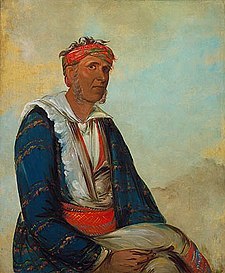
Hiwassee Island, located in Meigs County where the Hiwassee River joins the Tennessee River, used to be commonly called “Jolly’s Island” after the Cherokee leader who lived there. John Jolly, whose Cherokee name was Ahuludegi or Oolooteka, spoke no English and wore a buckskin hunting shirt, leggings and moccasins. After his brother, Tahlolnteeskee, departed for the West in 1809, Jolly became headman of Cayuga town on the island.
In that same year, the young Sam Houston came to live with the Cherokee on the island. Jolly adopted the boy and gave him the Cherokee name of Ka’lanu or Colonneh, meaning “The Raven.” Born in Rockbridge County, Va., in 1793, Houston emigrated to Tennessee in 1807 with his widowed mother and siblings to land near Kingsport. He went to school and kept the store before running away at the age of 16 to live with the Cherokees on Jolly’s island.
“This running wild among the Indians,” Houston later wrote, “seemed a pretty strange business, and people used to say that I would either be a great Indian chief, or die in a mad-house, or be governor of the State – for it was very certain that some dreadful thing would overtake me!” He lived among the Indians until he was 18, when he returned to Maryville to become a schoolmaster. He would not become governor of Tennessee until 1827, after first serving in the U. S. House of Representatives.
Meanwhile, the U.S. government through agent Return J. Meigs was encouraging Cherokees to relocate on land west of the Mississippi River. The Turkeytown Treaty of July 8, 1817, provided for the exchange of land in the east for land in northwest Arkansas. In February 1818, Chief John Jolly with 331 Cherokees left on 16 boats to emigrate to the Arkansas Territory. About 4,000 relocated altogether, becoming known as the Western Cherokee. After 1818 John Jolly served as principal chief. In 1819 British naturalist Thomas Nuttall described the Western Cherokee as having prosperous, well-tended farms. Upon meeting John Jolly and his wife on April 9, 1819, Nuttall wrote: “I should scarcely have distinguished him from an American, except by his language. He was very plain, prudent, and unassuming in his dress and manners; a Franklin among his countrymen, and affectionately called the beloved father.”
Seven years later, on April 16, 1829, Sam Houston resigned as governor of Tennessee, disgraced by his failed marriage to young Eliza Allen of Sumner County. He departed Nashville on a steamboat to the Mississippi, heading for the Indian country.