
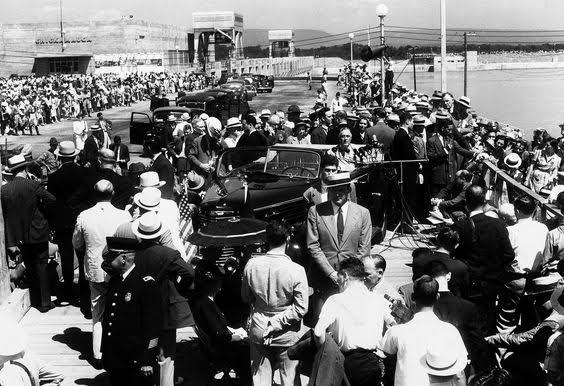
On Labor Day, Sept. 2, 1940, President Franklin Delano Roosevelt arrived in Chattanooga by train and rode in a motorcade to the Chickamauga Dam. Accompanying him were First Lady Eleanor Roosevelt, Gov. Prentice Cooper and Sen. Kenneth D. McKellar, who introduced the president to a crowd of 30,000 people.
The 71-year-old McKellar, who was running for a fifth term, introduced the president as the author of the Tennessee Valley Authority. In his speech Roosevelt characterized “this chain of man-made inland seas” as the South’s Great Lakes, opening “a new artery of commerce [and] new opportunities for recreation.”
He said the dam was “a demonstration of what a democracy at work can do,” and asserted “I glory in it as one of the great social and economic achievements of the United States.”
Roosevelt reminded his audience that two years earlier he had visited the dam to lay the cornerstone at the beginning of construction on the impressive structure. At that time he and his wife had visited the home of his good friend, Judge Will Cummings, in Lookout Valley. Cummings was Chattanooga’s first city court judge and later county judge from 1912 to 1918 and again from 1926 to 1942. He welcomed Roosevelt on this second visit as well. Cummings was very forward looking. He bought Chattanooga’s first automobile, played an important role in the construction of the Dixie Highway, and is remembered as a founder of the Tennessee Valley Authority.
Robert Sparks Walker reviewed the history of the project in “The Chickamauga Dam and Its Environs” (1949). It began when Congress passed the Tennessee Valley Authority Act of 1933 giving power to the board to construct dams in the Tennessee River. Work began on the Chickamauga Dam on Jan. 13, 1936. The filling of the reservoir began on Jan. 15, 1940, and the dam was finished on Jan. 31, 1941, five years after it was begun. The total cost, including land acquisition, was $42 million. According to Walker, about half of the watershed of 40,910 square miles is found upstream from the Chickamauga Dam. Watts Bar and Fort Loudoun dams are on that part of the river. Downstream from Chickamauga Dam the Tennessee River flows 471 miles through Nickajack, Guntersville, Wheeler, Wilson, Pickwick and Kentucky dams before emptying into the Ohio River 35 miles from its juncture with the Mississippi.