
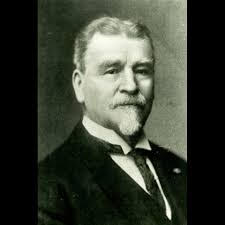
 Hiram S. Chamberlain
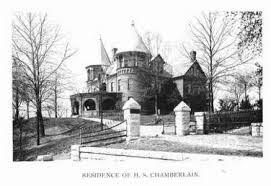
 Hiram S. Chamberlain’s residence
Longtime Chattanoogans probably remember Hiram Sanborn Chamberlain for the football stadium and field on Oak Street named after him. Chamberlain served as president of the board of trustees of the University of Chattanooga until his death at the age of 81 on March 15, 1916.
Chamberlain was born in Franklin, Ohio, on Aug. 6, 1835 to Vermont natives Leander and Susanna Chamberlain, the fourth of eight children. He attended the Eclectic Institute, later Hiram College, in Hiram, Ohio. There he became a student and friend of professor James A. Garfield, a future president of the United States. Garfield himself had been a student at the institute from 1851 to 1853 before attending Williams College. He returned to teach classical languages, mathematics and geology, as well as serving as the school’s principal between 1856 and 1861. When the Civil War began, Garfield resigned to join the Union Army as lieutenant-colonel of the 42nd Ohio Volunteer Infantry and fought in the battles of Shiloh and Chickamauga. He had attained the rank of major general by the time he resigned on Dec. 5, 1863, to serve in the U. S. House of Representatives.
After a short business career in Iowa, Hiram Chamberlain returned to Ohio and followed in Garfield’s footsteps. When war broke out, he promptly enlisted in the Second Ohio Volunteer Cavalry as a private but soon was commissioned second lieutenant and regimental quartermaster. After serving two years in Kansas and Missouri, Chamberlain became divisional quartermaster under Gen. Ambrose Burnside in Knoxville after the city was taken from the Confederates in 1863. In May, President Abraham Lincoln promoted him to captain and assistant quartermaster.
Chamberlain fitted out the 23rd Army Corps for Gen. John Schofield, then in command of the Chattanooga and Atlanta campaigns. Shortly before the war ended, Chamberlain again took the field as chief quartermaster of Gen. George Stoneman’s army operating in upper East Tennessee, southwest Virginia and western North Carolina. After the war he decided to remain in Knoxville, where he married Amelia Morrow in 1867. The couple had six children.
During their occupation of Knoxville, the Confederates had moved a small iron foundry from Loudon to Knoxville, but were unable to produce iron. When the Union forces occupied Knoxville in late 1863, Chamberlain and S.T. Atkins, a local manufacturer, got the foundry in working order and continued to operate it after the war.