
(First of two parts)
Bradford Torrey, a Boston journalist, wrote about a visit to the Chickamauga Battlefield in his 1895 “Spring Notes from Tennessee.” Below are excerpts.
“The field of Chickamauga – a worthily resounding name for one of the great battlefields of the world – lies a few miles south of the Tennessee and Georgia boundary, and is distant about an hour’s ride by rail from Chattanooga.
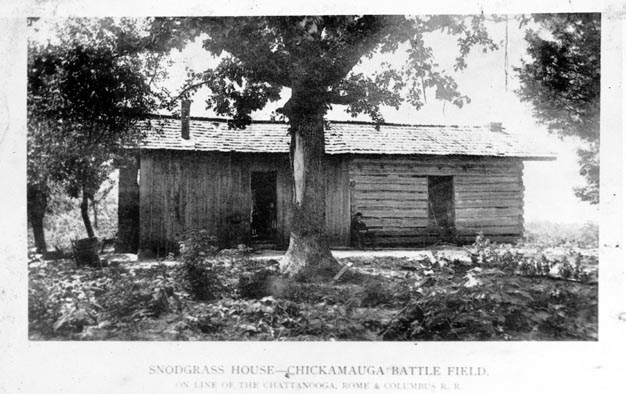
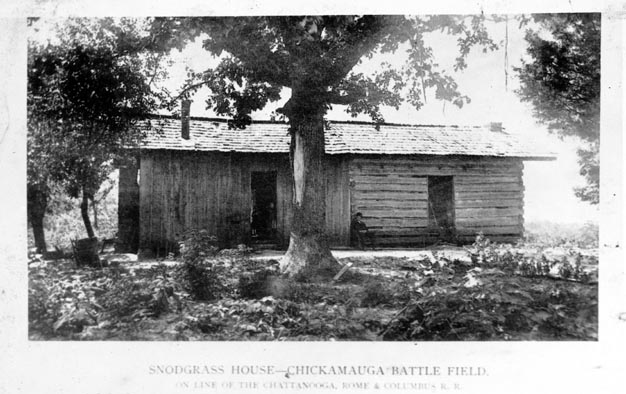 The Snodgrass House at Chickamauga and Chattanooga National Military Park. (Photo courtesy of the Chattanooga Public Library)
“From the railway station I followed a road that soon brought me to a comfortable, homelike house, with fine shade trees and an orchard. Here, in September 1863, lived John Dyer, who suddenly found his few peaceful acres surrounded and overrun by a hundred thousand armed men, and himself drafted into service as guide to the Confederate commander. Since then strange things had happened to the little farmhouse, which now was nothing less than a sort of government headquarters, as I rightly inferred from the general aspect of things round about, and the American flag flying above the roof.
“Two or three minutes afterward I came face to face with another apparition, a horseman as graceful and dignified, not to say majestic; a man in civilian dress, but visibly a soldier, with a pose and carriage that made shoulder-straps superfluous; a man to look at; every inch a major-general; of whom, I ventured to inquire, from under my umbrella, if there was any way of seeing some of the more interesting portions of the battlefield without too much exposure to the sun. He showed a little surprise (military gentlemen always do, so far as I have observed, when strangers address them), but recovered himself, and answered with almost affability. Yes, he said if I would take the first turn to the left, I should pass the spot over which Longstreet made the charge that decided the fate of the contest, and as he spoke he pointed out the field, which appeared to be part of the Dyer farm; then I should presently come within sight of the Kelly house, about which the fighting was of the hottest. I thanked him and followed his advice.