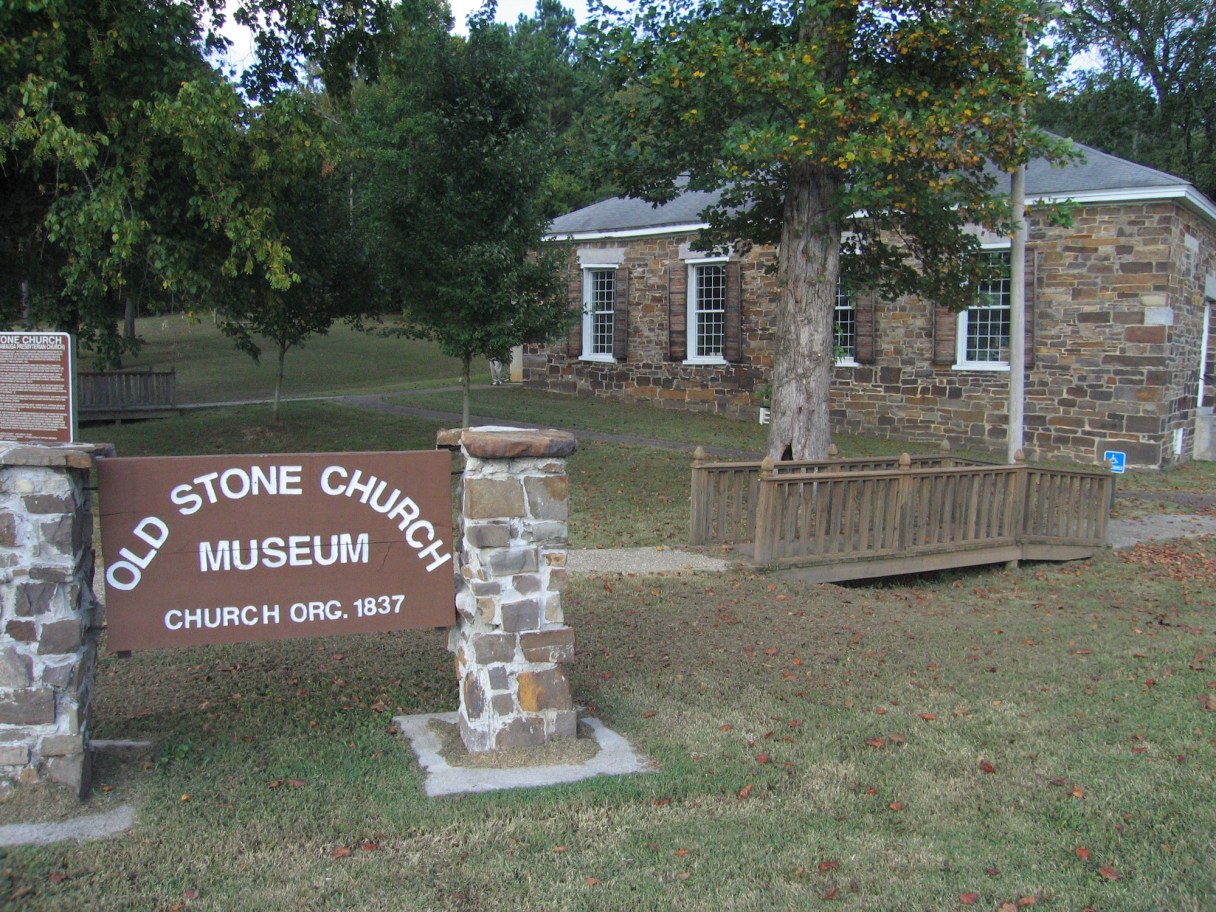
Those travelers on Interstate 75 with an interest in history should detour on exit 345, turn left on Highway 41 toward Ringgold and go 1/4 mile to the Old Stone Church Museum.
In 1837, a year before the Cherokee Indian removal, a group of devout Scotch-Irish Presbyterians came into the Cherokee Nation with the intent of forming a church. They found a spot 1/4 mile south of the Old Federal Road. A log cabin was built, and the Chickamauga Presbyterian Church was organized Sept. 2, 1837. The log cabin was used from 1837 to 1845, and a new site was selected one mile south of that location. A shed, measuring 40 feet by 70 feet, was constructed and referred to as the “Dogwood Campground.” The congregation met there until a new church was built.
In 1850 the congregation decided to build a more substantial church, and members used sandstone quarried from the nearby Stubblefield farm and lumber from Taylor’s Ridge to construct their church. Work was completed in 1852. Services began in what was later known as the Old Stone Church. It was constructed just a couple of hundred yards from the Old Federal Road. The Presbyterian congregation met there until services were interrupted by the War Between the States.
The most notable battle in the vicinity was the Battle of Ringgold Gap on Nov. 27, 1863. There is a statue of Gen. Patrick Clebourne in Ringgold Gap with a historical marker detailing the battle. The next two days saw thousands of Confederate soldiers passing through Ringgold on their way to Catoosa Station, a railroad station that also saw military action during the Civil War. As a result, the Old Stone Church was put into use as a Civil War hospital by both the Union and Confederate armies, and church services were suspended for two years. When Union forces occupied the church, the pews were taken out into the yard and were used for troughs to feed the Union Army horses. The imprint of the horses teeth can be seen in those pews today. Most notably, blood stains remain in the floor and are still visible to visitors. In addition to being used as a hospital, military dispatches and field reports during the Civil War indicate both Confederate and Union Armies used the building as headquarters and a major point of reference during the battles.
In 1887 A.J. Showalter preached at a revival service held at the Old Stone Church. Afterward, Elder I.L. Magill invited Showalter to his home for the mid-day meal. After the meal, Showalter went into the Magill parlor and composed the music to the poem “Leaning on the Everlasting Arms,” written earlier by Rev. Elisha Hoffman. The three Magill girls sang along, and at the evening services this hymn was sung for the first time at the Old Stone Church.
In 1920 the membership had dwindled at the Chickamauga Presbyterian Church, and the remaining congregation joined the Ringgold Presbyterian Church, which had just opened. The Old Stone Church was later bought by a group of Methodists, and the Harris Methodist Church was formed. The Methodist congregation met there until 1935, and the church then passed on to a Baptist congregation. In the early 1950s the Stone Church was used as a mission and was instrumental in training pastors to preach. In 1968 the Highland Park Baptist Church of Chattanooga owned one third interest in the building and used it as well.
The Old Stone Church achieved National Register Status in 1979 due to its historical significance and unique architecture.
In 1995, the Catoosa County Historical Society took steps to acquire the building for restoration. This effort was supported by the Catoosa County government and the state of Georgia. Plans were finalized and a grant was obtained. Society members and others began a renovation of the church that was completed in October of 1997. The Catoosa County Historical Society now meets there monthly and operates a history museum that is open Friday, Saturday and Sunday afternoons. Visitors can experience 169 years of history at a site that has witnessed the Cherokee Removal and the Civil War. The church contains original historic exhibits of the area. It is certainly worth the trip down I-75 to visit.
Jerry Summers is an attorney with Summers, Rufolo & Rodgers. Nancy Crowe is President of the Catoosa County Historical Society.
Read more Chattanooga History Columns
- Gaston: Paul John Kruesi was Edison’s right-hand man
- Robbins: The old Richardson’s house and the Civil War
- Gaston: James Williams was a man of the world
- Raney: Mason Evans, the ‘Wild Man of the Chilhowee’
- Gaston: The legacy of Adolph Ochs endures
- Martin: Ed Johnson said, ‘I have a changed heart,’ the day before his lynching in Chattanooga on 1906
- Thomas: The inventiveness of Judge Michael M. Allison
- Moore: Chattanooga’s first Chinese community
- Summers, Robbins: Chattanooga’s Tuskegee Airman – Joseph C. White
- McCallie: The Civil Rights Act of 1964 says so!
- Gaston: John McCline’s Civil War – from slave to D.C. parade
- Raney: Exploring Chattanooga businesses in the Green Book
- Elliott: Remembering the Freedmen’s Bureau in Chattanooga
- Gaston: Nancy Ward was a beloved, respected Tennessean
- Martin: Prohibition – the noble experiment
- Elliott: ‘A shameful, disgraceful deed’: The destruction of the Sewanee cornerstone
- Gaston: Robert Cravens was ironmaster, Chattanooga area’s first commuter
- Robbins: Dr. T.H. McCallie’s Christmas 1863
- Robbins: Journalist writes of a trip to Missionary Ridge in 1896
- Summers, Robbins: Mine 21 disaster – gone but not forgotten
- Elliott: Collegedale incorporates to avoid Sunday ‘blue laws’
- Gaston: ‘Marse Henry’ Watterson’s journalism fame began in Chattanooga
- Robbins: Orchard Knob battle recalled in 1895
- Elliott: Chattanoogans joined in an ‘orgy of joy and gladness’ on Armistice Day, 1918
- Thomas: Noted service, speakers are marks of Rotary Club of Chattanooga since 1914
- Summers and Robbins: Remembering noted Tennessee author North Callahan
- Raney: ‘I auto cry, I auto laugh, I auto sign my autograph’
- Gaston: Sequoyah’s alphabet enriched Cherokees
- Robbins: A look at Sam Divine’s life during the Civil War
- Robbins: Memories of a Confederate nurse
- Robbins: More notes from Bradford Torrey’s 1895 visit to Chickamauga Battlefield
- Robbins: Journalist in 1895 details visit to Chickamauga Battlefield
- Elliott: Telephone exchange firebombing was distraction for grocery store robbery
- Gaston: Worcester brought Christ’s message to Cherokee at Brainerd Mission
- Robbins: 1896 travel diary: ‘A Week on Walden’s Ridge’
- Gaston: Elizabeth Strayhorn, WAC Commandant at Fort Oglethorpe
- Robbins: The history of the Friends of Moccasin Bend National Park
- Moore: Do you own a Sears Roebuck home?
- Summers and Robbins: Camp Nathan Bedford Forrest in World War II
- Gaston: Hiram Sanborn Chamberlain remembered
- Elliott: Daisy the center of tile, ceramic manufacturing in Hamilton County
- Gaston: FDR inaugurates the Chickamauga Dam
- Summers, Robbins: Interned WWII Germans had it easy at Camp Crossville
- Elliott: A war correspondent on Lookout Mountain
- Gaston: Chickamaugas finally bury hatchet in Tennessee Valley
- Gaston: Chickamaugas in Chattanooga
- Robbins: The history of the Riverbend festival
- Raney: Sadie Watson, the first woman elected in Hamilton County government
- Moore: Remembering Chattanooga’s Hawkinsville community
- Elliott: Welsh coal miners transformed Soddy after the Civil War
- Gaston: Chattanooga’s best-kept secret
- Elliott: Cabell Breckinridge loses his horse
- Raney: Martin Fleming is the people’s judge
- Gaston: The amazing career of Francis Lynde
- Martin: Hamilton County’s Name Sake: Alexander Hamilton
- Summers, Robbins: The crosses at Sewanee
- Bledsoe: The fiery truce at Kennesaw Mountain
- Moore: Talented architect’s life cut short by tragedy
- Rydell: Chattanooga’s place in soccer history
- Robbins: Tennessee Coal, member of the First Dow Jones Industrial Average
- Raney: In the barber chair
- Lanier: Becoming the Boyce Station Neighborhood Association
- McCallie: John P. Franklin: Living history among us
- Barr: Chattanooga’s first railroad: The Underground Railroad
- Summers, Robbins: Charles Bartlett was a Pulitzer Prize winner, Kennedy confidant
- Rainey: ‘We have seen it’
- Elliott: Feinting and fighting at Running Water Creek and Johnson’s Crook
- Gaston: The Spring Frog Cabin at Audubon Acres
- Raney: Wauhatchie Pike was moonshine motorway
- Robbins: Oakmont was home of venerable Williams clan
- Summers and Robbins: Rebirth of the Mountain Goat Line
- Elliott: Bad investments led to Soddy Bank failure in 1930
- Summers and Robbins: Pearl Harbor attack left football behind
- Gaston: Jolly’s Island namesake had long ties with Sam Houston
- Return Jonathan Meigs, Indian Agent
- Moore: Did you know about St. Elmo’s other two cemeteries?
- Summers: Orme – Marion County’s almost lost community
- Davis: Spooky revival at Sharp Mountain in 1873
- Robbins: The story of Longholm
- Raney: Women labored to help the U.S. win World War I
- Even in the city, the ‘wheel’ changed everything
- Murray: Confederate dilemma after Chickamauga
- J.B. Collins — Newsman extraordinaire
- Robbins: The Story of the Lyndhurst Mansion
- Chattanooga artist and wife lost on the Lusitania
- Chattanooga History Column: Battelle, Alabama and the Battelle Institute
- John Ross, a founder of Chattanooga
- Hamilton County casualties in World War I
- Chattanooga Power Couple
- ‘Somewhere in France’
- The Ray Moss family
- Battery B from Chattanooga
- Ulysses S. Grant, Clark B. Lagow, and the Chattanooga Bender
- Songbirds Museum Timeline
- Hamilton County World War 1 roster
- The Soddy Girl and the Memphis Belle
- Blues icon Bessie Smith was the Empress of Soul
- Women’s Army Corps at Chickamauga
- Emma Bell Miles’ life at the top of the ‘W’
- The Tivoli Wurlitzer is one of Chattanooga’s priceless assets
- Chattanooga in struggle for freedom during Civil War
- October 1918, Chattanooga paralyzed by Spanish flu epidemic
- Eli Lilly and the Ditch of Death
- One hundred years ago, Chattanooga goes to war
- The legacy of Anna Safley Houston
- Harriet Whiteside was ahead of her time
- Southern Adventist University
- Chattanooga native’s writings aided Civil Rights movement
- Zion College, Chattanooga’s only African American College
- The North Shore’s hidden past
- Mayme Martin — Businesswoman and community leader
- Thomas Sim’s epic struggle for freedom
- Top of Cameron Hill was price of rerouting interstate
- Cameron Hill has rich history
- Temperance movement included Harriman university
- The sweetest music this side of Heaven
- Conquistadors at Chattanooga
- Chattanooga and the ‘General’
- Chattanooga’s first Thanksgiving, 1863
- Chattanooga’s greatest flood caught city unaware
- Opening the Cracker Line
- European trip in 1900 enlightens Sophia Scholze Long
- Sophia Scholze Long spoke out when others were silent
- Little South Pittsburg and its big silent movie stars
- Lot attendant recalls hottest job in Chattanooga
- Chattanooga’s Forest Hills is final resting place for known, unknown
- Burritt College — Pioneer of the Cumberlands
- Chattanooga’s nicknames trace city’s evolution
- The 25th annual meeting of the Tennessee Press Association
- Clemons Brothers Furniture Store
- The Short Life of the USS Chattanooga
- Ellen Jarnagin McCallie lived a truly remarkable life
- Dr. Jonathan Bachman was a revered city father
- Second guessing the Confederate failure on Missionary Ridge
- Nancy Kefauver, ambassador for the arts
- William Gibbs McAdoo kept his Southern roots
- Chattanooga’s Secretary of the Treasury
- Howard Baker remembered as a statesman/photographer who snapped history
- Tivoli’s last picture show
- The history of one of Chattanooga’s oldest businesses
- Chattanooga’s roller derby skaters
- Myths of Coca-Cola in Chattanooga
- Chattanooga’s neighborhood grocery stores
- The tale of the Scottsboro Boys
- The people’s history of Chattanooga
- Howard School is Chattanooga’s reminder of Reconstruction
- Elevator operator, painter, mystery man: meet Rice Carothers
- Raulston Schoolfield made enemies amid his rise to power
- Website lets users peer into Chattanooga’s past
- The flood of 1917
- Chattanooga’s ‘wickedest woman’ buried at Forest Hills
- History of Cummings Highway