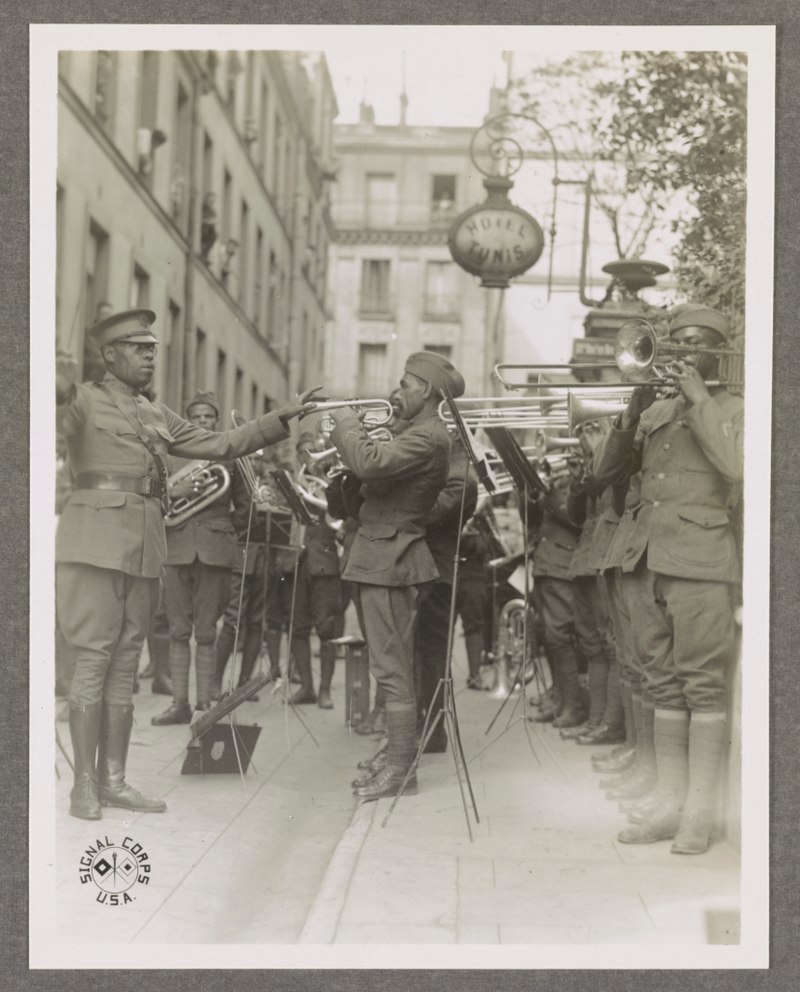
How might French military forces, Jazz and a specially-created New York regiment connect with the Medal of Honor? Each is an element in one of the most fascinating stories of The Great War.
When President Woodrow Wilson addressed the U.S. Congress on April 2, 1917, war had been raging across Europe since 1914. He announced the end of the U.S. policy of neutrality and asked Congress for a Declaration of War against the German aggressors and their allies. While fighting on foreign soil would be costly, Wilson identified the nation’s objective, “With confidence in our armed forces, with the unbounding determination of our people, we will gain the inevitable triumph – so help us God.”
When the United States realized that it did not have enough soldiers, Congress inked the Selective Service Act of 1917, requiring all men, 21-30, to register for the draft, including African Americans. The New York 369th Infantry, comprised primarily of African American troops joined by some Puerto Rican recruits, was called into action, completed training and was deployed to France.
On April 8, 1918, the unit was assigned to the French Army, primarily because white American soldiers refused to serve with them, and they were accepted by the French troops with “open arms.” After three years of devastating casualties, the French military welcomed assistance in their fight against their historic enemy, Germany. During the next few months, the Hellfighters fought from the French trenches, saw action in the Second Battle of the Marne and in the Allied counterattack in conjunction with the American drive in the Meuse-Argonne. On one tour, the Hellfighters were out for over six months, the longest deployment of any Great War unit.
The Harlem Hellfighters’ valor in combat was recognized with two Medals of Honor and numerous Distinguished Service Crosses.
The most famous of the Hellfighters was Henry Johnson, originally from Winston-Salem, North Carolina, who had moved to Albany, New York, as a young man. While serving on watch detail in France’s Argonne Forest in May 1918, Johnson fought off a German raid in hand-to-hand combat, mortally wounding multiple German soldiers and rescuing a fellow soldier while experiencing an almost unbelievable 21 wounds. Johnson’s story was heralded in the New York newspapers and in The Saturday Evening Post.
The French Government recognized Johnson’s heroism with the Croix de Guerre with star and bronze palm, the first U.S. soldier in the Great War to receive that honor. While he became a hero for many citizens, the U.S. Army did not single him out for commendation. However, upon his return to the U.S. in February 1919, the newly promoted Sgt. Johnson participated, along with the Harlem Hellfighters unit, in a victory parade through New York City. For a brief period, he traveled the country, sharing the stories of his service and the courageous actions of the unit, but in 1929, he died in poverty, generally forgotten.
In June 1996, President Bill Clinton posthumously awarded the Purple Heart to Johnson and, in February 2003, the Distinguished Service Cross, the Army’s second highest honor, was presented to Herman A. Johnson, one of the famed Tuskegee Airmen, on behalf of his father. On June 2, 2015, President Barack Obama presented the Medal of Honor to Johnson, received by Command Sgt. Maj. Louis Wilson of the New York National Guard. The president’s remarks included, “The least we can do is to say, ‘We know who you are, we know what you did for us. We are forever grateful!'”
And, what about the connection to jazz? The story is a perfect footnote to the legacy of the 369th Regiment and Henry Johnson.
The “Hellfighters Band,” whether playing for wounded soldiers during hospital treatment or entertaining troops during the silent moments between shellings, introduced an until-then unknown style called jazz to the British and French forces. By Armistice Day, Nov. 11, 1918, the “Hellfighters Band” had become one of the most famous military bands in U.S. history. As the leaders of the New York City parade honoring the returning Harlem Hellfighters, the band led the regiment members down Fifth Avenue, following a route that would eventually end in Harlem. The parade became a marker of African American service to the nation, and the band’s music would help ignite a Renaissance in Harlem and a new campaign for civil rights.
Linda Moss Mines is the Chattanooga-Hamilton County historian, vice president for education for the Coolidge National Medal of Honor Heritage Center and regent, Chief John Ross Chapter, NSDAR.
Read more Chattanooga History Columns
- Gaston: Paul John Kruesi was Edison’s right-hand man
- Robbins: The old Richardson’s house and the Civil War
- Gaston: James Williams was a man of the world
- Raney: Mason Evans, the ‘Wild Man of the Chilhowee’
- Gaston: The legacy of Adolph Ochs endures
- Martin: Ed Johnson said, ‘I have a changed heart,’ the day before his lynching in Chattanooga on 1906
- Thomas: The inventiveness of Judge Michael M. Allison
- Moore: Chattanooga’s first Chinese community
- Summers, Robbins: Chattanooga’s Tuskegee Airman – Joseph C. White
- McCallie: The Civil Rights Act of 1964 says so!
- Gaston: John McCline’s Civil War – from slave to D.C. parade
- Raney: Exploring Chattanooga businesses in the Green Book
- Elliott: Remembering the Freedmen’s Bureau in Chattanooga
- Gaston: Nancy Ward was a beloved, respected Tennessean
- Martin: Prohibition – the noble experiment
- Elliott: ‘A shameful, disgraceful deed’: The destruction of the Sewanee cornerstone
- Gaston: Robert Cravens was ironmaster, Chattanooga area’s first commuter
- Robbins: Dr. T.H. McCallie’s Christmas 1863
- Robbins: Journalist writes of a trip to Missionary Ridge in 1896
- Summers, Robbins: Mine 21 disaster – gone but not forgotten
- Elliott: Collegedale incorporates to avoid Sunday ‘blue laws’
- Gaston: ‘Marse Henry’ Watterson’s journalism fame began in Chattanooga
- Robbins: Orchard Knob battle recalled in 1895
- Elliott: Chattanoogans joined in an ‘orgy of joy and gladness’ on Armistice Day, 1918
- Thomas: Noted service, speakers are marks of Rotary Club of Chattanooga since 1914
- Summers and Robbins: Remembering noted Tennessee author North Callahan
- Raney: ‘I auto cry, I auto laugh, I auto sign my autograph’
- Gaston: Sequoyah’s alphabet enriched Cherokees
- Robbins: A look at Sam Divine’s life during the Civil War
- Robbins: Memories of a Confederate nurse
- Robbins: More notes from Bradford Torrey’s 1895 visit to Chickamauga Battlefield
- Robbins: Journalist in 1895 details visit to Chickamauga Battlefield
- Elliott: Telephone exchange firebombing was distraction for grocery store robbery
- Gaston: Worcester brought Christ’s message to Cherokee at Brainerd Mission
- Robbins: 1896 travel diary: ‘A Week on Walden’s Ridge’
- Gaston: Elizabeth Strayhorn, WAC Commandant at Fort Oglethorpe
- Robbins: The history of the Friends of Moccasin Bend National Park
- Moore: Do you own a Sears Roebuck home?
- Summers and Robbins: Camp Nathan Bedford Forrest in World War II
- Gaston: Hiram Sanborn Chamberlain remembered
- Elliott: Daisy the center of tile, ceramic manufacturing in Hamilton County
- Gaston: FDR inaugurates the Chickamauga Dam
- Summers, Robbins: Interned WWII Germans had it easy at Camp Crossville
- Elliott: A war correspondent on Lookout Mountain
- Gaston: Chickamaugas finally bury hatchet in Tennessee Valley
- Gaston: Chickamaugas in Chattanooga
- Robbins: The history of the Riverbend festival
- Raney: Sadie Watson, the first woman elected in Hamilton County government
- Moore: Remembering Chattanooga’s Hawkinsville community
- Elliott: Welsh coal miners transformed Soddy after the Civil War
- Gaston: Chattanooga’s best-kept secret
- Elliott: Cabell Breckinridge loses his horse
- Raney: Martin Fleming is the people’s judge
- Gaston: The amazing career of Francis Lynde
- Martin: Hamilton County’s Name Sake: Alexander Hamilton
- Summers, Robbins: The crosses at Sewanee
- Bledsoe: The fiery truce at Kennesaw Mountain
- Moore: Talented architect’s life cut short by tragedy
- Rydell: Chattanooga’s place in soccer history
- Robbins: Tennessee Coal, member of the First Dow Jones Industrial Average
- Raney: In the barber chair
- Lanier: Becoming the Boyce Station Neighborhood Association
- McCallie: John P. Franklin: Living history among us
- Barr: Chattanooga’s first railroad: The Underground Railroad
- Summers, Robbins: Charles Bartlett was a Pulitzer Prize winner, Kennedy confidant
- Rainey: ‘We have seen it’
- Elliott: Feinting and fighting at Running Water Creek and Johnson’s Crook
- Gaston: The Spring Frog Cabin at Audubon Acres
- Raney: Wauhatchie Pike was moonshine motorway
- Robbins: Oakmont was home of venerable Williams clan
- Summers and Robbins: Rebirth of the Mountain Goat Line
- Elliott: Bad investments led to Soddy Bank failure in 1930
- Summers and Robbins: Pearl Harbor attack left football behind
- Gaston: Jolly’s Island namesake had long ties with Sam Houston
- Return Jonathan Meigs, Indian Agent
- Moore: Did you know about St. Elmo’s other two cemeteries?
- Summers: Orme – Marion County’s almost lost community
- Davis: Spooky revival at Sharp Mountain in 1873
- Robbins: The story of Longholm
- Raney: Women labored to help the U.S. win World War I
- Even in the city, the ‘wheel’ changed everything
- Murray: Confederate dilemma after Chickamauga
- J.B. Collins — Newsman extraordinaire
- Robbins: The Story of the Lyndhurst Mansion
- Chattanooga artist and wife lost on the Lusitania
- Chattanooga History Column: Battelle, Alabama and the Battelle Institute
- John Ross, a founder of Chattanooga
- Hamilton County casualties in World War I
- Chattanooga Power Couple
- ‘Somewhere in France’
- The Ray Moss family
- Battery B from Chattanooga
- Ulysses S. Grant, Clark B. Lagow, and the Chattanooga Bender
- Songbirds Museum Timeline
- Hamilton County World War 1 roster
- The Soddy Girl and the Memphis Belle
- Blues icon Bessie Smith was the Empress of Soul
- Women’s Army Corps at Chickamauga
- Emma Bell Miles’ life at the top of the ‘W’
- The Tivoli Wurlitzer is one of Chattanooga’s priceless assets
- Chattanooga in struggle for freedom during Civil War
- October 1918, Chattanooga paralyzed by Spanish flu epidemic
- Eli Lilly and the Ditch of Death
- One hundred years ago, Chattanooga goes to war
- The legacy of Anna Safley Houston
- Harriet Whiteside was ahead of her time
- Southern Adventist University
- Chattanooga native’s writings aided Civil Rights movement
- Zion College, Chattanooga’s only African American College
- The North Shore’s hidden past
- Mayme Martin — Businesswoman and community leader
- Thomas Sim’s epic struggle for freedom
- Top of Cameron Hill was price of rerouting interstate
- Cameron Hill has rich history
- Temperance movement included Harriman university
- The sweetest music this side of Heaven
- Conquistadors at Chattanooga
- Chattanooga and the ‘General’
- Chattanooga’s first Thanksgiving, 1863
- Chattanooga’s greatest flood caught city unaware
- Opening the Cracker Line
- European trip in 1900 enlightens Sophia Scholze Long
- Sophia Scholze Long spoke out when others were silent
- Little South Pittsburg and its big silent movie stars
- Lot attendant recalls hottest job in Chattanooga
- Chattanooga’s Forest Hills is final resting place for known, unknown
- Burritt College — Pioneer of the Cumberlands
- Chattanooga’s nicknames trace city’s evolution
- The 25th annual meeting of the Tennessee Press Association
- Clemons Brothers Furniture Store
- The Short Life of the USS Chattanooga
- Ellen Jarnagin McCallie lived a truly remarkable life
- Dr. Jonathan Bachman was a revered city father
- Second guessing the Confederate failure on Missionary Ridge
- Nancy Kefauver, ambassador for the arts
- William Gibbs McAdoo kept his Southern roots
- Chattanooga’s Secretary of the Treasury
- Howard Baker remembered as a statesman/photographer who snapped history
- Tivoli’s last picture show
- The history of one of Chattanooga’s oldest businesses
- Chattanooga’s roller derby skaters
- Myths of Coca-Cola in Chattanooga
- Chattanooga’s neighborhood grocery stores
- The tale of the Scottsboro Boys
- The people’s history of Chattanooga
- Howard School is Chattanooga’s reminder of Reconstruction
- Elevator operator, painter, mystery man: meet Rice Carothers
- Raulston Schoolfield made enemies amid his rise to power
- Website lets users peer into Chattanooga’s past
- The flood of 1917
- Chattanooga’s ‘wickedest woman’ buried at Forest Hills
- History of Cummings Highway