
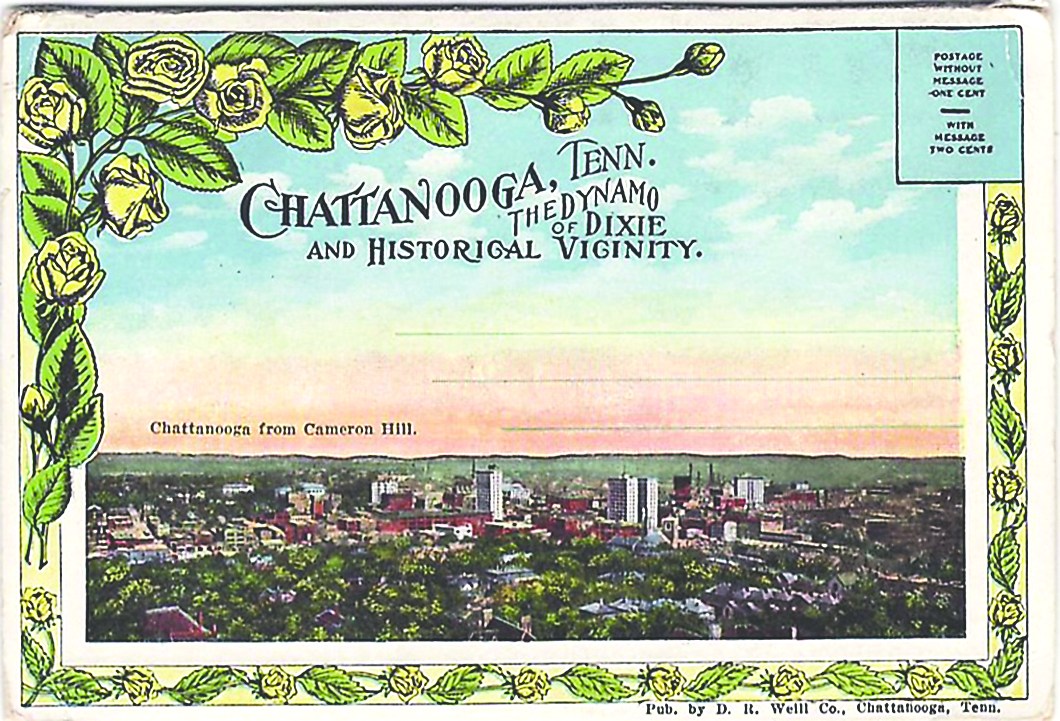
Promoting Chattanooga has been part of its culture for decades. Flyers published by the Chattanooga Automobile Club in the 1920s lured prospective visitors with “SIGHTSEEEING such as you have never enjoyed before awaits you in Chattanooga,” “CHATTANOOGA The South’s most interesting city” and “See the Scenic and Historic Splendors of the South.” In 1925, the Exchange Club promoted “the Honeymoon City” and “Friendly City.” In 1992, the Chamber of Commerce’s slogan was “Live it. Love it. It’s Chattanooga.” “Chattanooga Shines” is a slogan of later vintage. A recent brochure endorsed the city as a “fabulous place to live and work” and an area “rich in history, bright in promise.”
Over the years, three general labels – “scenic, historic and commercial” – have been used repeatedly to describe the city.
To support its scenic label, letters and articles since its early years have highlighted the area’s mountain vistas and sparkling waters. Confederate nurse Kate Cumming wrote in her 1863 journal that the scene from Lookout Mountain was one of the “most beautiful pictures [she had] ever beheld.” Early Chattanooga Automobile Club pamphlets and articles proclaimed the “rugged beauty of mountain ranges and peaceful calm of valley lands combine with associations of historic interest to afford the sightseer the most superb scenery to be found anywhere.” Chattanooga reigns today as the “Scenic Center of the South.”
Because of its strategic importance during the Civil War, Chattanooga became known as the “Gateway to the South.” In June 1934, Arthur Snell, executive director of the Chattanooga Chamber of Commerce, called Chattanooga the “Crossroads of the South,” recognizing the many roads and railroads that ran through Chattanooga. He estimated that more than 500,000 people lived within a 50-mile radius of Chattanooga. Today, the Chattanooga Convention Center markets the city’s central location, noting that “Chattanooga is located within a day’s drive from more than half the population of the United States.” Many of these travelers come to enjoy the area’s scenery.
In support of its history label, Chattanooga has witnessed two monumental events that have been recognized far and wide. Ross’s Landing, the site of Indian settlement, is considered to be the major embarkation point of the Cherokee removal in 1838 in the tragic Trail of Tears. During the Civil War in 1863, Chattanooga saw the Battle of Chickamauga, the Siege of Chattanooga, The Battle Above the Clouds, and finally the Battle of Missionary Ridge, which opened the door for Sherman’s March to the Sea.