
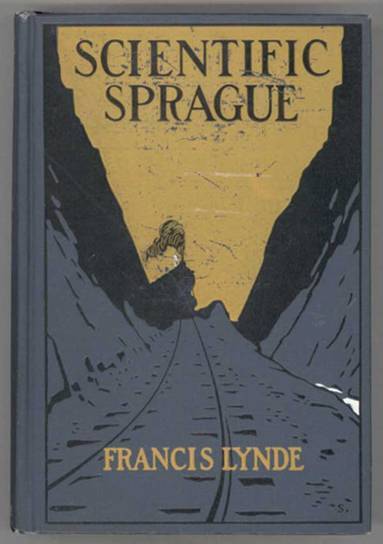
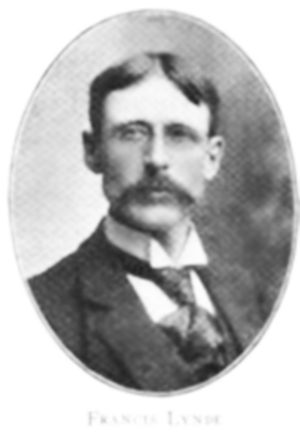
Few Chattanoogans are aware that our most prolific local author lies in Forest Hills Cemetery, where he was buried on May 19, 1930. He was Francis Lynde (pronounced “lined”), born in Lewiston, N.Y., on Nov. 12, 1856. Fans of detective thrillers and westerns revere Lynde even today. He brought both genres together in his 1912 collection of stories, “Scientific Sprague.” In this book he pitted Sprague, a detective-railroad engineer, against thieves, accidents and inventions in the hands of unscrupulous villains. Lynde was ahead of his time when he featured the discovery of nuclear energy in his story “The Earthquakers,” published in the January 1930 issue of Popular Magazine. His fame spread after three of his stories were made into films.
Ron Scheer, author of “How the West was Written,” wrote that Lynde attended public school in Missouri and was a Union Pacific Railroad employee for 13 years before becoming a writer. Lynde’s short fiction appeared in magazines like Munsey’s as early as 1894. In 1904 he began his long relationship with Popular Magazine. Altogether Lynde published more than two dozen novels and well over 100 works of short fiction and serials. In 1926 the University of the South awarded him an honorary Doctor of Letters degree.
Elizabeth Fry Page’s interview with Lynde appeared in The Olympian Magazine, Vol. 2, in 1903. She reported that he married his wife Mary Antoinette Stickle (1867-1960), whom she described as a “cheery and blue-eyed” helpmate, when living in Denver. In search of a reclusive environment to write, they moved to Cravens Terrace on Lookout Mountain, where they built their unique stone house, “Wideview,” on Hardy Trail. Here the Lyndes raised a family of two boys and two girls in a home that Page described as a “commodious but unpretentious” cottage.
Some distance across the yard from the house and near the bluff, Lynde built with his own hands a literary retreat. It was a good-sized room with an alcove, high windows and a rugged chimney of mountain stone. She reported, “Mr. Lynde does his composing on a typewriter, which he keeps on a high stand, and as he walks up and down the room in meditation upon his theme, he will pause in passing and pound out a sentence or two, or several pages, as the case may be.”
The observant reporter added that Lynde kept on his desk a Texas critic’s review of his novel, “The Master of Appleby”: “It is a pretty book of 581 pages, with a miracle of heroism on every page. There is enough adventure in it for a complete set of Waverlys [novels by Sir Walter Scott]. It has ‘atmosphere’ so thick it hangs like a fog, and ‘color’ so glaring that it hurts the eyes. As for language, it fills the whole 581 pages with a prodigality that is nothing less than sinful. It is a brave tale utterly spoiled with bravery. Yet it is beautifully conceived and artistically set in the smoke of the Revolution and the primeval forest. The phrasing is iambic: it would transpose easily into swinging heroics.”