
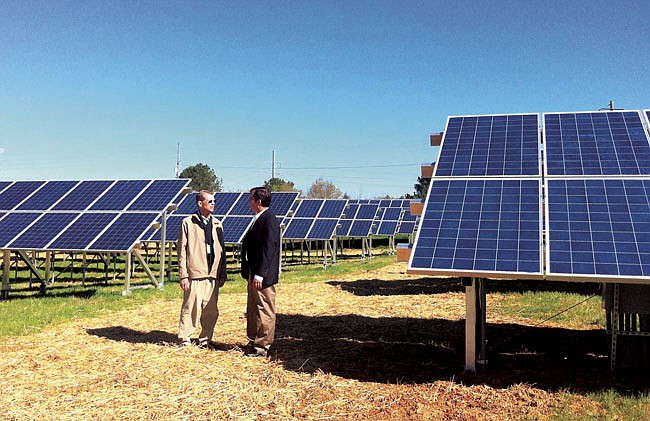
 Mike Jolley, vice president and head of special projects at Dalton Utilities, and William Silva, president of United Renewable Energy, stand among the recently installed solar panels in southern Whitfield County.
Staff Photo by Mariann Martin/Chattanooga Times Free Press
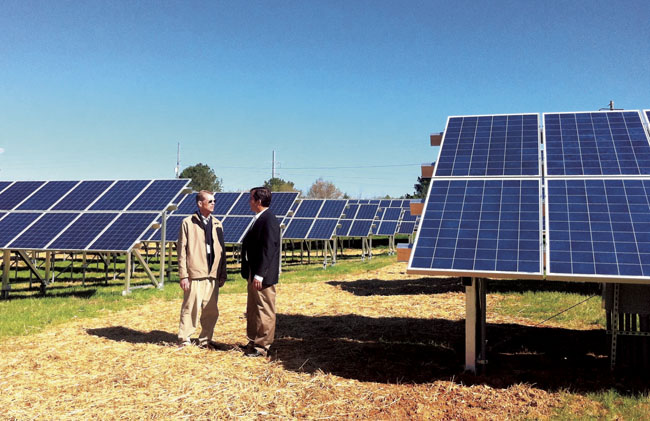
Mike Jolley, vice president and head of special projects at Dalton Utilities, and William Silva, president of United Renewable Energy, stand among the recently installed solar panels in southern Whitfield County.
Staff Photo by Mariann Martin/Chattanooga Times Free PressDALTON, Ga. - In less than two months, a grassy field in southern Whitfield County has been transformed into a solar farm, with rows and rows of solar panels soaking up the bright spring sunshine.
Nearby, a digital monitor tracks each kilowatt of renewable energy created and used in homes all across Dalton.
"The project went extremely smoothly," said Mike Jolley, vice president and special projects manager with Dalton Utilities. "It is putting out more energy than we had anticipated."
Georgia Power Co. financed and owns the five-acre solar farm, United Renewable Energy built the system and Dalton Utilities will purchase and distribute the solar power.
In nearly two weeks of operation, the farm has been producing about 95 percent capacity - about 10 percent more than officials had hoped for, Jolley said. So far, the kilowatts produced could supply two homes with power for a year, he said.
The initial 1,560 solar panels now in operation generate about 350 kilowatts of energy a day. Two more phases, with the same number of solar panels in each phase, will be added, with the second phase targeted for the end of this year.
The panels are designed to have at least a 30-year life span and require almost no day-to-day maintenance or operating costs, said Shana Haygood, chief operating officer for United Renewable Energy.
Located on a portion of Dalton Utilities' Land Application System previously used to treat sewage, the solar panels were installed with minimal impact to the land, she said.
Dalton Utilities will purchase the solar power for 22.6 cents per kilowatt under a 25-year lease agreement. That is more expensive than the average cost of the mix of coal, hydro, nuclear and gas power that the company uses now, but solar power is an important part of the mix for Dalton Utilities, Jolley said.
"It is a very small percentage of the total electricity we use, and the cost will not affect our rates," he said. "Solar power is innovative and environmentally friendly. At some point, Georgia is going to require utilities to use some renewable energy. We will already be ahead of the game."
Haygood said it is exciting to see the way Dalton has embraced solar power. Several large manufacturing plants and businesses in Dalton have installed solar panels that supply part of their power directly to the plant, Haygood said.
With federal and state tax incentives and deprecation write-offs, a business can pay for the costs of the panels and installation in about 41/2 years on average, Haygood said.