

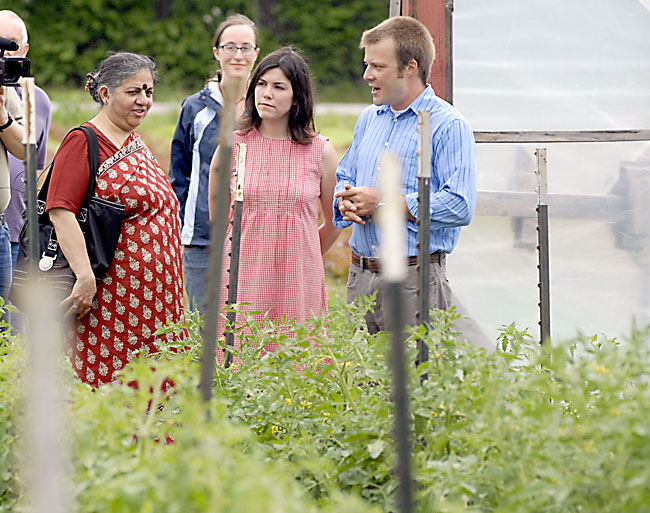
 Dr. Vandana Shiva, left, tours Crabtree Farms on Tuesday with Executive Director Joel Houser, right, and Melanie Mayo, director of outreach and education. Standing behind them is Crabtree Farms intern Andrea Jaeger. Shiva, an advocate for "a clean and just food system," is making a three-day visit to the Chattanooga area.
Staff Photo by John Rawlston/Chattanooga Times Free Press
Dr. Vandana Shiva, left, tours Crabtree Farms on Tuesday with Executive Director Joel Houser, right, and Melanie Mayo, director of outreach and education. Standing behind them is Crabtree Farms intern Andrea Jaeger. Shiva, an advocate for "a clean and just food system," is making a three-day visit to the Chattanooga area.
Staff Photo by John Rawlston/Chattanooga Times Free PressTHREE TIPS* Grow a backyard garden* Avoid fast food* Buy produce from local farmersSource: Dr. Vandana Shiva
A world-renowned environmental leader had a strong message Tuesday for Chattanooga fans of Whoppers, Krystals and McNuggets.
"To anyone who grabs anything because it's accessible, cheap," said Dr. Vandana Shiva, of India, "You might think that is sustainable in terms of time management, but it's horribly non-sustainable in terms of body management."
A vice president of Slow Food International, Shiva had just finished a tour of Crabtree Farms, where fruits and vegetables rule, pesticides are panned and plastic is shunned "out of conviction," according to executive director Joel Houser.
The Benwood Foundation funded Shiva's visit and public lecture Tuesday night at the University of Tennessee at Chattanooga through Gaining Ground, a three-year, $1.65 million investment to establish a local food economy.
Over and over, Shiva encouraged Chattanooga residents, even "the tiniest child with an edible school yard," to grow their own food, eat organic and shun mass distributors.
"Corporations decide how they'll stuff us with all the nonsense of the world," she said. "We need to widen the concept of the price of food beyond the labeled price, which hides all kinds of costs."
Despite her comments, a Benwood-backed study shows how difficult it is to eat healthy in what the report called "food deserts."
In the five regions of Hamilton County with the highest rates of food stamp usage - Amnicola/East Chattanooga, Downtown, Bushtown/Highland Park, Ridgedale/Oak Grove/Clifton Hills and South Chattanooga - nearly 90 percent of the food retailers accepting food stamps are gas stations and convenience stores that rarely sell fruits and vegetables, according to a 2009 Ochs Center for Metropolitan Studies report.
Some of those neighborhoods have the highest poverty and obesity ratings in Hamilton County, the report shows.
Gaining Ground director Jeff Pfitzer said his organization has spent a lot of time trying to bring healthy food to those communities, including sending chefs to urban schools to give students cooking lessons on simple, healthy dishes.
He said a website with all the recipes would be helpful.
"Then again," he said, "we have a challenge of poverty where websites are far from ubiquitous in these communities."
But Shiva gave an example of why she believes local food options in Chattanooga one day will trump the quick Walmart or grocery store run.
Every morning, a "tiny vendor" visits her doorstep in India to deliver potatoes, eggplants and tomatoes, she said, and she doesn't have to move - "what could be easier than that?"
"I think each of us was designed to be creative," Shiva said. "In the food system, to create means to produce."