
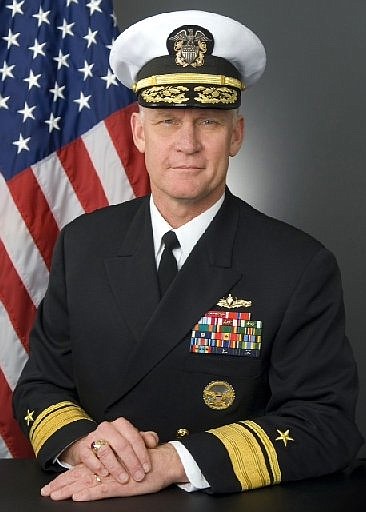
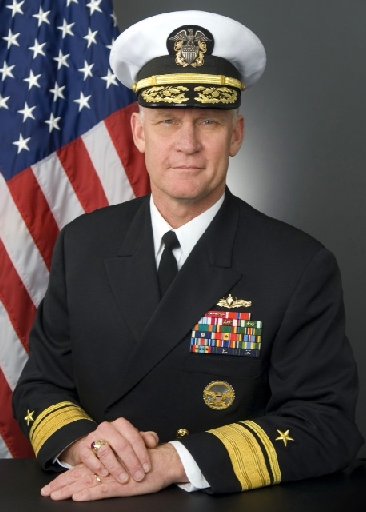
 Rear Admiral Nevin Carr, Chief of Naval Research
A military with edge demands cutting-edge research, says Rear Adm. Nevin Carr, the U.S. Navy's chief of Naval Research.
"There's a lot of foreign competition in research," he said. "Innovation remains critical in this day and age."
Carr was in town Tuesday evening, speaking at a dinner for the Navy League of the United States' Greater Chattanooga Council, a civilian organization that works to support the Navy and educate citizens about sea power.
During his speech at the Chattanooga Choo-Choo, Carr chiefly discussed the Navy's current research developments and elaborated on the balance between guided governmental research and dependence on independent contractors.
He also detailed recent Navy innovations, spanning everything from products that clot blood more quickly to electromagnetic rail guns, a weapon that fires its projectile at Mach 7, about 5,400 mph.
Although there is currently "downward pressure" on funding, Carr said, funds for science and technology research remain protected.
Earlier in the day, Carr received a briefing at the University of Tennessee at Chattanooga's SimCenter, which specializes in computational modeling, simulation and design.
"They're doing some very impressive work there," Carr said.
Charles Dammann, who served with the Navy in the 1960s, was interested in hearing Carr's report on the Navy's scientific advancements. Dammann said the Navy now is vastly different than the one he served in.
"They have so much technology now and that completely changes the experience," he said. "We didn't even have air conditioning then."
Contact staff writer Kate Harrison at kharrison@times freepress.com or 423-757-6673.