
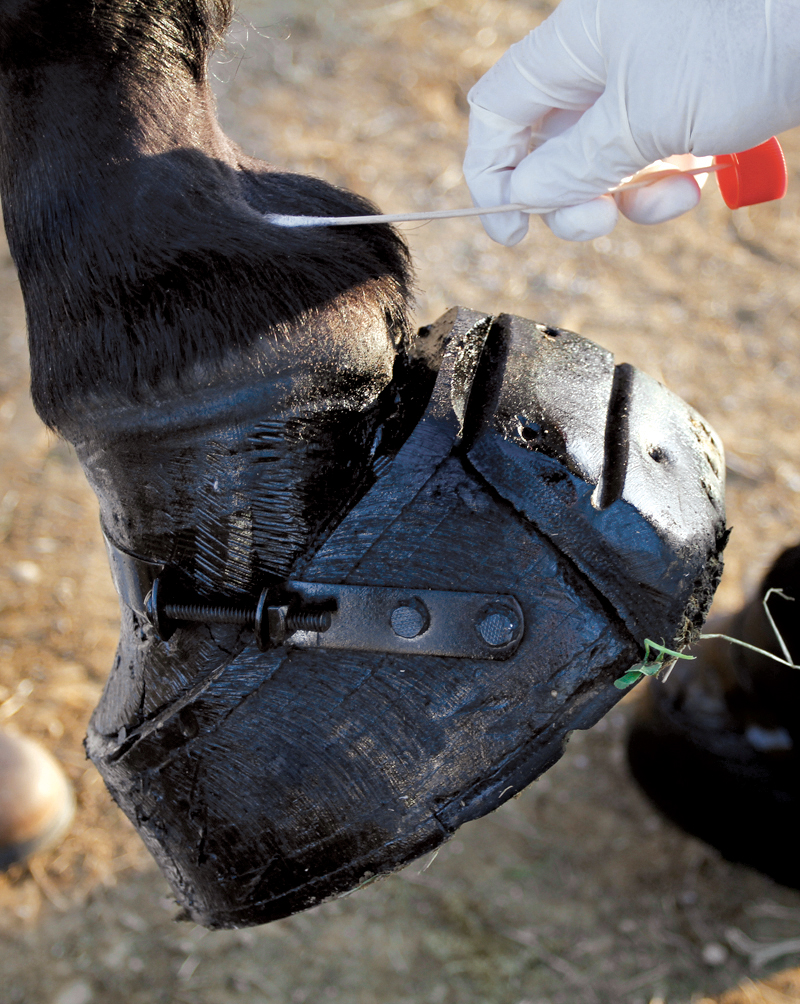
 Staff Photo by Alyson Wright
Stack on the hoof of a walkng horse.
The horse soring case against Jackie McConnell, a nationally known Tennessee Walking Horse trainer who had pleaded guilty in an unusual 52-count indictment involving himself and a couple of stable hands, ended Tuesday in federal court here with a notably weak sentence: three years probation and a $75,000 fine. His sentence made headlines because it is just the second criminal case — the first occurred last year — brought under the Horse Protection Act since the law was adopted more than 40 years ago, and because horse soring has long stained Tennessee’s nationally prominent annual Walking Horse Celebration in Shelbyville.
But his light sentence is most noteworthy because it illustrates why the Horse Protection law should be upgraded to a felony with stricter penalties, including imprisonment, and tighter standards on what constitutes soring of horses feet.
The lenient sentence, in fact, stands as a symbol of a fundamental flaw in the current law: it still allows owners and trainers to attach heavy, 4-inch-high shoes on gaited show horses’ front hooves with chains and metal straps to hold the stacks — deceitfully misnamed as “pads” — on horses’ hooves. That compresses their hooves and undeniably and painfully alters their natural gait.
Officials and trainers for the Tennessee Walking Horse competitions that celebrate the artificially induced, high-stepping gait — known as “the big lick” — contend the stacks should continue to be allowed. They claim to be working to rid the industry of the intentional soring of the Walkers’ front feet through the use of chemicals, chains and metal objects implanted at the top of the stack, all of which have been used to make horses raise the front feet high to escape pain. But they argue the stacks remain necessary to enhance the big lick that distinguishes high-stepping Walkers from traditional flat-shod Walkers, whose gait rarely includes an extremely high, champion-winning step.
That very difference in the gaits is one measure of the need to ban the use of high stacks. Another is the health result for horses made to suffer the high stacks. Horses being trained regularly with hoof-stacks for shows are generally confined to stalls and small paddocks. If they are allowed to run freely in a typical pasture, they may throw off the stacks, causing leg and foot injuries and lameness.