
On April 5, 1917, prominent farmer Sam Julian of the Shepherd community (near today’s Lovell Field) brought his only son, 18-year-old Earl S. Julian, to the recruiter for the Tennessee National Guard. His proud father noted that Earl “doesn’t know anything about military service, but he’s sure a good boy on the farm and at home.”
Two years and two months later, across Hamilton County, the Ladies’ Aid Society of the Daisy Methodist Church presented a play titled “The Minister’s Wife’s New Bonnet.” Part of the proceeds from the production went to erecting a monument to “the heroes of the recent war from the Daisy vicinity.”
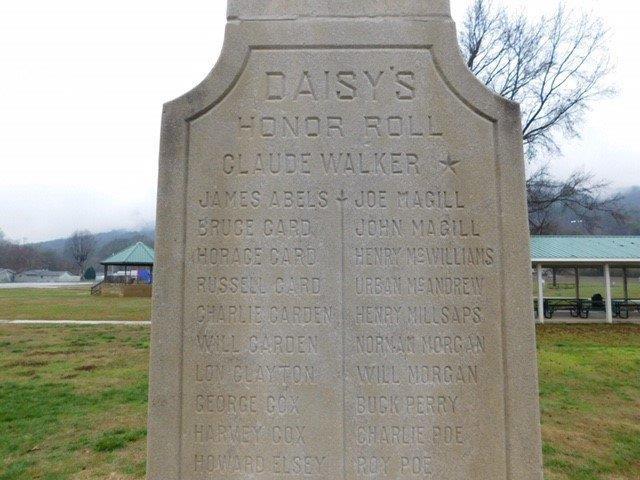
That monument, originally erected in front of the old Daisy Elementary, was moved some years ago to the Veterans Park in Soddy-Daisy. The names of 48 men appear on the monument, who with young Earl Julian, were only a small portion of the nearly 5,000 residents of Hamilton County who served in the World War I era.
Appearing on the top of the Daisy monument is the name of Claude Walker. Walker’s is the only name with a star beside it, indicating he was the sole serviceman from Daisy who made the supreme sacrifice in the war. Walker was drafted Sept. 5, 1918, and shipped overseas Sept. 29. But on Oct. 15, 1918, he died from pneumonia, probably secondary to the Spanish flu, and was buried in France.
There were 117 Hamilton County service deaths during the Great War, Walker being one of at least 64 who died from disease, usually pneumonia, but also malaria, diphtheria, “dilatation of the heart” and, ignominiously, syphilis.